 (I gave this model to Prof. Qian-Er Zhang 張乾二 in Xian last August. Feb. 4, 2013)
Monday, May 9, 2011
A new trefoil knot
Here is a new trefoil knot by Chern. Unlike the previous trefoil knot, this new construction has much less strain and distortion. In this sense, the corresponding fullerene structure should be more stable.
 (I gave this model to Prof. Qian-Er Zhang 張乾二 in Xian last August. Feb. 4, 2013)
(I gave this model to Prof. Qian-Er Zhang 張乾二 in Xian last August. Feb. 4, 2013)


Thursday, April 28, 2011
Structural types of TCNTs
A few weeks ago, I was informed by my colleague about a paper by Beuerle et al.[1], in which they identified eight structural types of high-symmetry achiral toroidal carbon nanotubes (TCNTs) based on two of our papers in J. Chem. Inf. Model.[2,3]
These eight structural types of TCNTs are
A. Type I, Parallel Prism; outer-rim: zigzag, inner-rim: zigzag: T240, another example, detailed construction
B. Type I, Parallel Prism; outer-rim: armchair; inner-rim: armchair: Two more models
C. Type III, Parallel anti-Prism; outer-rim: zigzag; inner-rim: zigzag: T120, Another T120, T240, T240
D. Type III, Parallel anti-Prism; outer-rim: armchair; inner-rim: armchair: T140, model 2
E. Type II, Anti-parallel Prism; outer-rim: zigzag; inner-rim: armchair: T250,
F. Type II, Anti-parallel Prism; outer-rim: armchair; inner-rim: zigzag: T240
G. Type IV, anti-Parallel anti-Prism; outer-rim: zigzag; inner-rim: armchair T240, T360
H. Type IV, anti-Parallel anti-Prism; outer-rim: armchair; inner-rim: zigzag: T240, T240, detailed construction
Here, we used zigzag and armchair patterns along lattitude coordinates, instead of using chiral vectors, (1,0) and (1,1). We have all these eight structural types in our first paper without giving them names though. In addition to these TCNTs with well-defined latitudes, we also included some high-symmetry TCNTs without latitudes (not in these eight types) in our papers. They seem to ignore them. Here is an example of TCNT (with the detailed construction) that does not belong to these eight structural types. Chuang and I are working on a comment to clarify these three extra types of TCNTs and the correct relationship (transformations) among these 11 types of TCNTs.
1. F. Beuerle, C. Herrmann, A. C. Whalley, C. Valente, A. Gamburd, M. A. Ratner, J. F. Stoddart, Optical and Vibrational Properties of Toroidal Carbon Nanotubes. Chem. Eur. J. 2011, 17, 3868-3875. See also Hot topic on carbon from Wiley-VCH.


2. C. Chuang, Y.-C Fan, B.-Y Jin, "Generalized Classification Scheme of Toroidal and Helical Carbon Nanotubes." J. Chem. Inf. Model. 2009, 49, 361-368.
pdf
3. C. Chuang, Y.-C Fan, B.-Y Jin, "Dual Space Approach to the Classification of Toroidal Carbon Nanotubes." J. Chem. Inf. Model. 2009, 49, 1679-1686.
pdf
These eight structural types of TCNTs are
A. Type I, Parallel Prism; outer-rim: zigzag, inner-rim: zigzag: T240, another example, detailed construction
B. Type I, Parallel Prism; outer-rim: armchair; inner-rim: armchair: Two more models
C. Type III, Parallel anti-Prism; outer-rim: zigzag; inner-rim: zigzag: T120, Another T120, T240, T240
D. Type III, Parallel anti-Prism; outer-rim: armchair; inner-rim: armchair: T140, model 2
E. Type II, Anti-parallel Prism; outer-rim: zigzag; inner-rim: armchair: T250,
F. Type II, Anti-parallel Prism; outer-rim: armchair; inner-rim: zigzag: T240
G. Type IV, anti-Parallel anti-Prism; outer-rim: zigzag; inner-rim: armchair T240, T360
H. Type IV, anti-Parallel anti-Prism; outer-rim: armchair; inner-rim: zigzag: T240, T240, detailed construction
Here, we used zigzag and armchair patterns along lattitude coordinates, instead of using chiral vectors, (1,0) and (1,1). We have all these eight structural types in our first paper without giving them names though. In addition to these TCNTs with well-defined latitudes, we also included some high-symmetry TCNTs without latitudes (not in these eight types) in our papers. They seem to ignore them. Here is an example of TCNT (with the detailed construction) that does not belong to these eight structural types. Chuang and I are working on a comment to clarify these three extra types of TCNTs and the correct relationship (transformations) among these 11 types of TCNTs.
1. F. Beuerle, C. Herrmann, A. C. Whalley, C. Valente, A. Gamburd, M. A. Ratner, J. F. Stoddart, Optical and Vibrational Properties of Toroidal Carbon Nanotubes. Chem. Eur. J. 2011, 17, 3868-3875. See also Hot topic on carbon from Wiley-VCH.
2. C. Chuang, Y.-C Fan, B.-Y Jin, "Generalized Classification Scheme of Toroidal and Helical Carbon Nanotubes." J. Chem. Inf. Model. 2009, 49, 361-368.
3. C. Chuang, Y.-C Fan, B.-Y Jin, "Dual Space Approach to the Classification of Toroidal Carbon Nanotubes." J. Chem. Inf. Model. 2009, 49, 1679-1686.
Monday, April 4, 2011
Ponytail holder
Children's day (兒童節) is celebrated today (4 April) in Taiwan. My niece made a ponytail holder with two buckyballs.
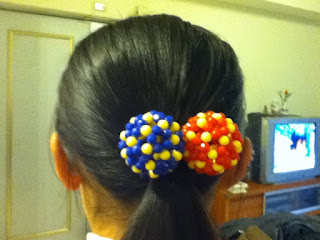

Sunday, March 20, 2011
繽紛多彩的串珠分子世界 (國際化學年,IYC-2011)
We made a poster (in Chinese) for the "Chemistry in Action" held here in Taiwan to celebrate the International Year of Chemistry (IYC-2011).


Thursday, March 17, 2011
Ih-Symmetric C380: A layer-by-layer inspection
Previously, Bih-Yaw posted a beaded version of this molecule. It is one particular example of a "High-genus fullerene", where the phrase high-genus literally means "many holes", and fullerene is a nickname of a family of cage-like molecules that consist of exclusively graphitic carbon. You can view these molecular structures as two-layered figures. And it is exactly the holes that connect the two layers.
Here we shall inspect the molecule, which is composed of 380 carbon atoms, layer by layer. Readers can then follow this route to construct their own beaded version of the structure. However, please bear in mind that beads should be placed at the edges of the figure. Bead represents chemical bond instead of atom despite of its round shape.
The inner layer is composed of 20 nine-member rings (nonagon):
They sit at the threefold rotational axis of icosahedral symmetry, similar to the hexagons in the pattern of a soccer ball. We notice that there are twelve fivefold symmetric holes each surrounded by five nonagons. It would not surprise a mathematician that these holes are located at the fivefold rotational axis of icosahedral symmetry, and again, similar to the pentagons of a soccer ball.
Next, each of the holes is crowned with five extra heptagons. Simple arithmetic tells us that there are total sixty of them.
Finally, the molecule is completed by filling out the space between the holes with hexagons. There are ninety of them in total.
I've mentioned that this molecule has 380 atoms. (So it is abbr. as C380 by chemists.) Since beads stand for bonds instead of atoms, 380*3/2=570 beads are required to build this molecule.
Here we shall inspect the molecule, which is composed of 380 carbon atoms, layer by layer. Readers can then follow this route to construct their own beaded version of the structure. However, please bear in mind that beads should be placed at the edges of the figure. Bead represents chemical bond instead of atom despite of its round shape.
The inner layer is composed of 20 nine-member rings (nonagon):
They sit at the threefold rotational axis of icosahedral symmetry, similar to the hexagons in the pattern of a soccer ball. We notice that there are twelve fivefold symmetric holes each surrounded by five nonagons. It would not surprise a mathematician that these holes are located at the fivefold rotational axis of icosahedral symmetry, and again, similar to the pentagons of a soccer ball.
Next, each of the holes is crowned with five extra heptagons. Simple arithmetic tells us that there are total sixty of them.
Finally, the molecule is completed by filling out the space between the holes with hexagons. There are ninety of them in total.
I've mentioned that this molecule has 380 atoms. (So it is abbr. as C380 by chemists.) Since beads stand for bonds instead of atoms, 380*3/2=570 beads are required to build this molecule.
Wednesday, March 16, 2011


Subscribe to:
Posts (Atom)