Showing posts with label activities. Show all posts
Tuesday, July 16, 2024
Thursday, July 10, 2014
Workshop for the NTU CampCamp
The first few slides and a few photos from the workshop I had for the NTU ChemCamp this afternoon in the Chemistry Building of National Taiwan University:
Wednesday, July 9, 2014
First slides for my talk in Center for Synchrotron Radiation and workshop for the Chemcamp
I have two opportunities to talk about the mathematical beading this month. The first one was given to people working at the Center of Synchrotron Radiation on Jul. 1. The first slide of the talk is given here:
Tomorrow I will give a 40-min talk before the hands-on workshop for about 30 high-school students who participate the Chemcamp these few days. The first slide of the talk is given as follows.
Tuesday, July 8, 2014
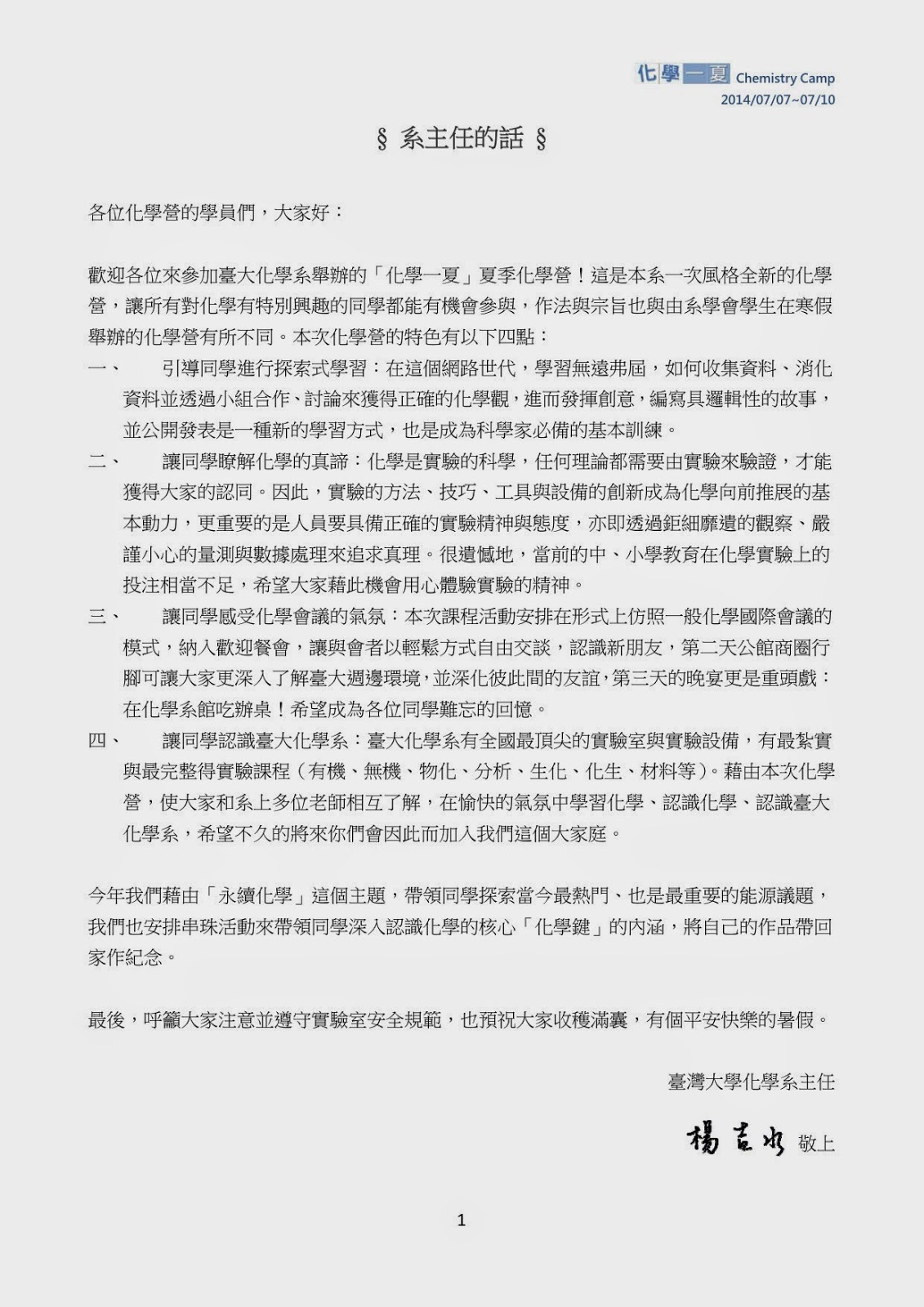
2014 NTU Summer Chemcamp (臺大暑期化學營)
These few days, there is a chemistry camp at the Chemistry Department of National Taiwan University (NTU). I was asked to give a workshop on the last day (Jul. 10, 2014) of this activity for these high-school kids coming from around the whole Taiwan and the Penhu islands (or the Pescadores Islands). The camp started yesterday afternoon, I had an opportunity to introduce them briefly about my beadworks in front of two display cases. Here are two photos from the event:
The first few pages of the handout for this chemcamp.
Monday, July 7, 2014
Workshop in Seoul
Mr. Horibe and I will give a workshop for the Bridges conference this coming August. Basically, we will follow the format we had in our joint workshop given in Taiwan this March. Horibe-San will first give a half-hour talk on the Sangaku in general and a special Sangaku problem in particular. And he will further describe the math about this Sangaku problem, particularly its connection to the continued fraction and then proceed to the construction of a physical model of this Sangaku problem before all participants make their own models that consist of 30 small wooden balls and a central large Ping-Pong ball.
Here are two photos of Mr. Horibe from workshop held in the math department of Academia Sinica (in the NTU main campus, Taipei) on Mar. 15.
The workshop paper, From Sangaku Problems to Mathematical Beading: A Hands-on Workshop for Designing Molecular Sculptures with Beads, can be found here (pdf file).
Here are two photos of Mr. Horibe from workshop held in the math department of Academia Sinica (in the NTU main campus, Taipei) on Mar. 15.
The workshop paper, From Sangaku Problems to Mathematical Beading: A Hands-on Workshop for Designing Molecular Sculptures with Beads, can be found here (pdf file).
Sunday, March 16, 2014
A pleasure to greet two friends from afar
Takaaki Sonoda and Kazunori Horibe visited me for the last few days. I arranged a few workshops for them in two local high schools, Taipei First Girls High School and Chian-Kuo High School, and a meeting on the mathematical art and games. A few photos from these activities:
Taipei First Girls High School
Chien-Kuo High School
Little Mama Bear (bead store)
Math department, Academia Sinica
Inside the cubic Kaleidoscopes
I made a Kaleidocycle and a stella octangula for them as gifts:
Unfortunately, Takaaki didn't know that they are fragile and broke the stella octangula the first day. So I made one more Kaleidocycle for him.
The opening of the Analects by Confucius and thus the first phrase of Chapter I after which the Chinese title of this book is named 學而.
學而時習之、不亦說乎。有朋自遠方來、不亦樂乎。人不知而不慍、不亦君子乎。
Isn't it a pleasure to study and practice what you have learned? Isn't it also great when friends visit from distant places? If one remains not annoyed when he is not understood by people around him, isn't he a sage?
Taipei First Girls High School
Chien-Kuo High School
Little Mama Bear (bead store)
Math department, Academia Sinica
Inside the cubic Kaleidoscopes
I made a Kaleidocycle and a stella octangula for them as gifts:
Unfortunately, Takaaki didn't know that they are fragile and broke the stella octangula the first day. So I made one more Kaleidocycle for him.
The opening of the Analects by Confucius and thus the first phrase of Chapter I after which the Chinese title of this book is named 學而.
學而時習之、不亦說乎。有朋自遠方來、不亦樂乎。人不知而不慍、不亦君子乎。
Isn't it a pleasure to study and practice what you have learned? Isn't it also great when friends visit from distant places? If one remains not annoyed when he is not understood by people around him, isn't he a sage?
Monday, December 30, 2013
Friday, November 16, 2012
The introduction to quasicrystal in Zometool website
I saw a page at zomeool company website about the quasicrystal model made by the zometool. There is a paragraph about the model displayed in the 2nd floor, outside the Pan-Guan Lecture Room of the chemistry departmen, National Taiwan University. My former student, Hsin-Yu Ko, kindly introduced the model to the students from the King David School in Taipei, possibly early last summer.
The history of the zometool model of this quasicrystal is here.
Thursday, November 15, 2012
準晶模型的前世與今生 The evolution of the 3D quasicrystal model
I wrote something in my facebook about the origin of the zometool model of quasicrystal (mainly in Chinese with a little bit English) which my students and I designed and created :
準晶模型的前世與今生 The evolution of the 3D quasicrystal model
Helen Yu, the dealer of zometool in Taiwan, also posted a lot of photos about the reconstruction of this model together with the carbon onion at the National Taiwan Science Education Center here:
Gluing& Hanging Models (Photo Credits)- keeping uploading..
準晶模型的前世與今生 The evolution of the 3D quasicrystal model
Helen Yu, the dealer of zometool in Taiwan, also posted a lot of photos about the reconstruction of this model together with the carbon onion at the National Taiwan Science Education Center here:
Gluing& Hanging Models (Photo Credits)- keeping uploading..
Monday, November 12, 2012
Tuesday, November 6, 2012
Zometool: quasicrystal and carbon onion
National Taiwan Science Education Center (NTSEC, 國立臺灣科學教育館) is going to have new area for the chemistry demonstration. They also decided to hang the two zometool models, carbon onion and quasicrystal, we designed, constructed and donated (Chemistry department, National Taiwan University). However, the original structures, particularly the quasicrystal, are not stable enough to be hung under the ceiling. So we decided to strengthen the original quasicrystal model by adding a stick along the short diagonal of each face. These sticks are blue, which, I believe, can make the the whole model much more colorful. Additionally, my students have also carefully glued each part together. It takes a lot of work. So, the whole project is still unfinished yet.
From left to right: 郭岷翔,范原嘉(Yuan-Jia, Fan),詹欣穆,秦逸群,黃泓穎 (photo by Helen Yu)
Monday, August 6, 2012
Quasicrystal zometool model donated to the National Taiwan Science Education Center (NTSEC, 國立臺灣科學教育館).
A few months ago, I decided to donate the two zometool models of quasicrystal and six-layer carbon onion to the National Taiwan Science Education Center (NTSEC, 國立臺灣科學教育館). Finally, Hsin-Yu, Yuan-Chia and some other students of mine moved these two models to the NESEC last week.
Originally, due the the tight budget, we couldn't really make the complete zometool model of quasicrystal consisting of stellated rhombic triacontahedra up to the second level. Fortunately, Ms. Helen Yu, the owner of a local Kindergarden, kindly supported us to finish this two-level quasicrystal structure. Here are a few photos from the special activity with kids from the Helen's Kindergarden.
Yuan-Chia and Hsin-Yu explained the construction rules to Kids:
Kids were working on the basic units:
Hsin-Yu, Bang-Rui, Yuan-Chia, I-Chun, and Hsin-Mu took a picture together in front of this beautiful zometool model of quasicrystal:
Originally, due the the tight budget, we couldn't really make the complete zometool model of quasicrystal consisting of stellated rhombic triacontahedra up to the second level. Fortunately, Ms. Helen Yu, the owner of a local Kindergarden, kindly supported us to finish this two-level quasicrystal structure. Here are a few photos from the special activity with kids from the Helen's Kindergarden.
Yuan-Chia and Hsin-Yu explained the construction rules to Kids:
Kids were working on the basic units:
Hsin-Yu, Bang-Rui, Yuan-Chia, I-Chun, and Hsin-Mu took a picture together in front of this beautiful zometool model of quasicrystal:
Wednesday, July 25, 2012
這一年我們一起串的巴克球!! (The buckyballs we bead together this year)
I got an announcement (in Chinese) about an activity or more exactly a competition to make beaded buckyballs for local high-school students.
Thursday, May 31, 2012
Wednesday, May 9, 2012
Zometool models at the Quasicrystal international conference
The newest Nobel laureate in Chemistry, D. Shechtman, was invited to Taiwan to participate a quasicrystal international conference held in the National Taipei University of Technology (May 7-9), a university very close to the National Taiwan University where I am working.
Yuan-Chia, Qian-Rui, and Hsin-Yu moved the two large zometool models, a 3D quasicrystal consisting of two types of golden rhombohedra (prolate and oblate) and a six-layer carbon onion (C20, C80, C180, C320, C500, and C720), to the conference's lobby area. Most participants seem to enjoy these two types of quasicrystal models, cluster and tiling, a lot.
Prof. Shechtman took a picture of me in front of the zometool model of carbon onion.
I also gave Prof. Shechtman a bead model of high-genus fullerene, a topologically nontrivial quasicrystal :-), as a gift.
Yuan-Chia, Qian-Rui, and Hsin-Yu moved the two large zometool models, a 3D quasicrystal consisting of two types of golden rhombohedra (prolate and oblate) and a six-layer carbon onion (C20, C80, C180, C320, C500, and C720), to the conference's lobby area. Most participants seem to enjoy these two types of quasicrystal models, cluster and tiling, a lot.
Prof. Shechtman took a picture of me in front of the zometool model of carbon onion.
I also gave Prof. Shechtman a bead model of high-genus fullerene, a topologically nontrivial quasicrystal :-), as a gift.
Subscribe to:
Posts (Atom)