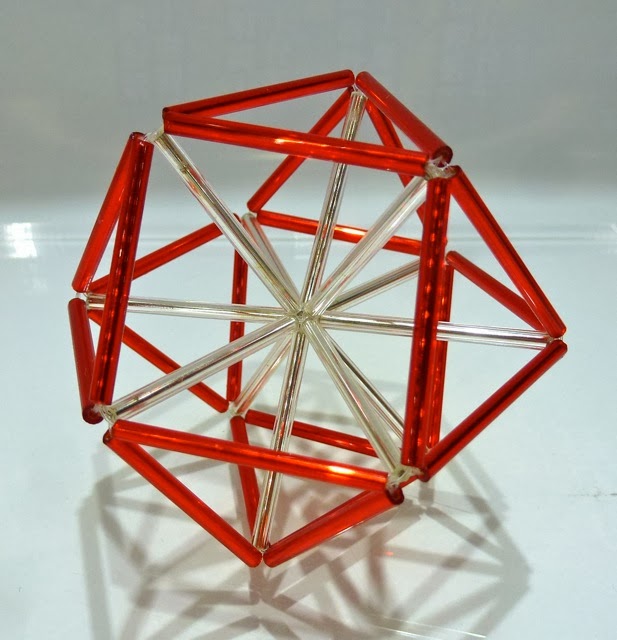
Most of cage-like fullerenes belong to either icosahedral or tetrahedral groups. But if we remove the restriction of using only pentagons and hexagons, we can create cage-like fullerenes with octahedral symmetry (or cubical shape) too. Of course, all P-type TPMSs, which are extended systems, posted before have the same symmetry. But I have never made cage-like fullerenes with cubical shape before. I found a few examples of cage-like fullerenes with cubical shape in an interesting book with the title, Periodic Nanostructures, by M. V. Diudea and C. L. Nagy recently. In this structure, each face contains an octahedron surrounded by four pentagons, which give a topological charge of 2. There are six faces in a cube, so the total topological charge is 12 as required by the Euler theorem. It is also easy to see that the eight vertices of this molecule are covered by flat coronenes. Therefore, the molecule looks like a cuboctahedron (立方八面體).

It is not hard to see that one can grow eight carbon nanotubes along eight vertices of the cube. The result will be a
Schoen's I-WP surface I described before. If one inserts six tubes along the six faces, one get a single unit cell of the P-surface. Or
one can also terminate the CNTs to get a dendritic fullerene with a cubic-shape core.