Showing posts with label T240. Show all posts

Monday, December 27, 2010

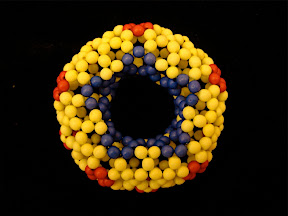
Two more toroidal carbon nanotubes

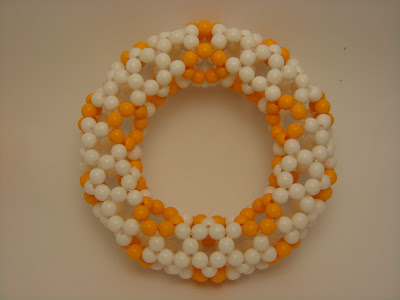
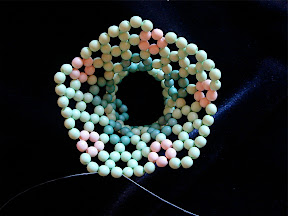
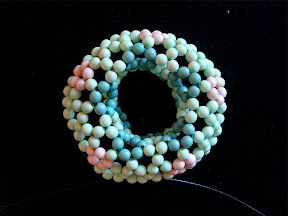
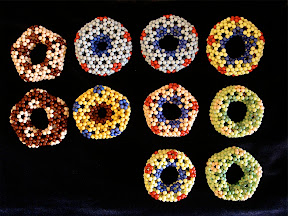
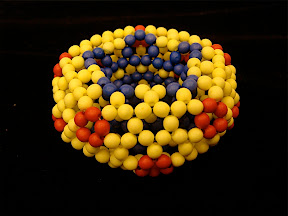
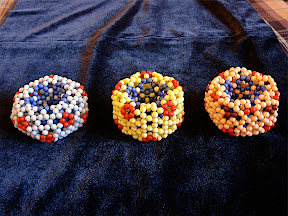
I made two more bead models for toroidal carbon nanotubes with 120 and 240 carbon atoms last weekend (Christmas holliday in many countries, but not here in Taiwan, :-)).

Tuesday, July 13, 2010

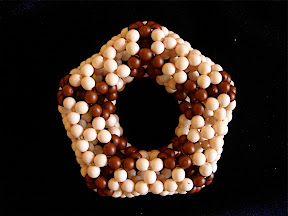
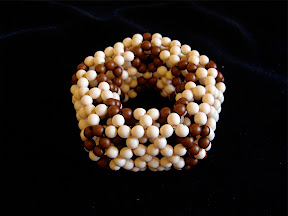
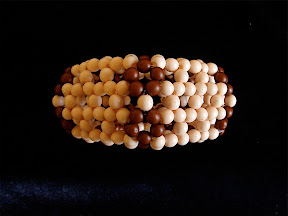
Another set of beaded T240

Chuang and I are particularly interested in toroidal shape of graphitical structures or carbon donuts. Systematic structural rules of this type of molecules have been worked out by us. The details were presented in these two articles:

1. "Generalized Classification Scheme of Toroidal and Helical Carbon Nanotubes." J. Chem. Inf. Model. 2009, 49, 361-368.
pdf

2. "Dual Space Approach to the Classification of Toroidal Carbon Nanotubes." J. Chem. Inf. Model. 2009, 49, 1679-1686.
pdf

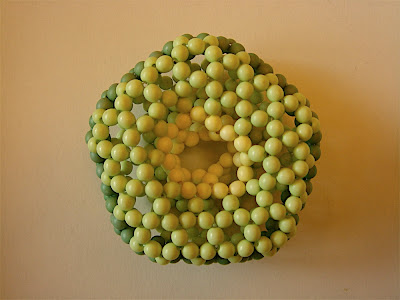
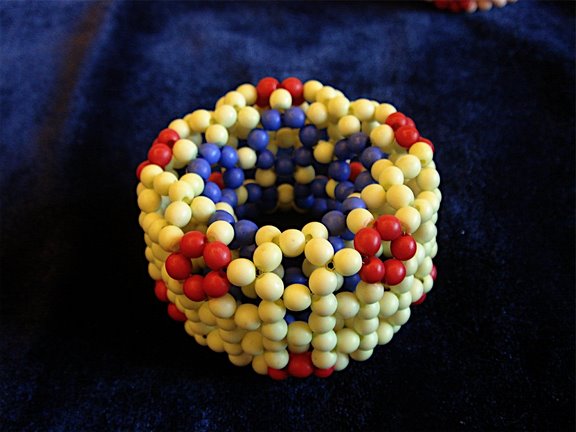
We have made many bead models for carbon donuts. Here are a few models for isomers of TCNT (Toroidal carbon nanotube) with 240 carbon atoms. Since beads stand for carbon-carbon bonds (edge of the graph), one need 360 beads to create one such structure. The basic construction procedure is basically the same for all TCNTs. The difference is where and when to put a heptagons and pentagons for a particular TCNT.


(Constructed by Chuang)

Wednesday, June 9, 2010

More toroidal carbon nanotubes (TCNTs)

Here are a few toroidal carbon nanotubes I made a long time ago. There are two types of TCNTs. Smaller TCNTs consist of 120 carbon atoms. So we need 180 beads to construct them.

Larger TCNTs consists of 240 atoms. So a total number of 360 beads are needed to make them.


Friday, June 1, 2007

The First Beaded T240 (D5d)

This is the first beaded T240 I made right after I bought the materials from the Little Bear's Mother and made my first C60 last year. This beaded torus was made from 360 10mm faceted beads. It is easy to see that there are some loose ends of threads in this beaded torus since I was not very good at handling these remaining threads at that time. It is not very supprising that I chose monochromic beads for weaving this torus.

At that time, I am still not familiar with the best algorithm for weaving a torus, not to mention the possibility to put beads with different colors on the pentagons and heptagons. Therefore, this first T240 has only one color.

Wednesday, April 25, 2007

The Beaded Models of 12 Stable T240 isomers

Finally, I have all 12 isomers of T240:

The corresponding computer-generated geometry for these models are

The one with orange color is the newest T240 I made. I knew this one should exist long time ago. But I don't know why I didn't make this one until a few weeks ago.

The first three tori in the bottom row are chiral isomers of T240. I have only made one for each pair of the enantiomers. If these three are counted twice, the total number of stable isomers of T240 should be 15 as I mentioned before.

Among all of these models, I like the four in the first row and the three in the right column most because the symmetry and shape these six isomers have. In fact I have made several duplicates of the top four and the middle one in the right column. But all of them have been given away as souvenir. Now these are the only T240 I have.

Wednesday, April 18, 2007

Another chiral twisted T240 with small inner-rim

I guessed I must have lost count how many beaded models I have made. In fact, I made a twisted T240 isomer derived from the parent isomer, I1, long time ago. Fortunately, the one I made last week is the other enantiomer of twisted T240.
Here is the picture for I6:

Friday, April 13, 2007

19 Isomers of T240

Here is the list of stable isomers of T240. According to Chuang's generation algorithm for the toroidal compounds, there are 40 isomers for T240. By simple inspection, I think more than half of them are probably unstable, particularly those with very large radius and very small girth. If chiral compounds are not counted twice, there are 14 isomers. These stable isomers can be classified into five type based on the arrangement of heptagons in the inner-rim as shown in the following figures.

Currently, I have created the beaded models for 12 of them. Only I5 and II5 are missing. This kind of isomers is related to their parent isomers, I1 and II1 by twisting the upper and lower parts of the torus respectively.

According to my previous experience, the isomers generated by this kind of transformation seem to be quite unstable as shown in one of my previous post. But the calculation based on Chuang's simple force field suggests that this kind of isomers could sometimes be stable depending on the type of inner-rim.


No beaded models for I5 and I6.


No beaded models for II5 and II6.


The tori in these figures are generated by the matlab scripts written by Chuang Chern, possibly with many useful discussions with Fan Yuan-Jia.

Sunday, April 8, 2007

Carbon Innertube

According to Chuang's exhausted search of carbon tori with 240 atoms and simultaneously satisfying C5 rotational symmetry and IPR (Independent Pentagon Rule), there are many possible isomers for T240. Out of these compounds, I found 19 stable isomers which I discussed in our group blog before (http://byjingroup.blogspot.com/). Here is one of T240 with a shape very similar to innertube.


Moreover, I suspect this is the only fullerene with this shape. I don't have proof, though.

Optimized shape of this molecule generated by Chuang.

Friday, January 5, 2007

Monday, December 18, 2006

Two conformations of the upper branch

In the process of weaving either branches of the toroid, it is not hard to notice that the beads on the edge form a large pentagon. It is understandable since there are exactly ten heptagons arranged in a petagonic pattern in the inner-rim. The extension of of the inner-rim outward by weaving more beads into the structure make the pentagon pattern even more vivid.

If we only introduce hexagons, the resulting structure is going to be like a funnel on both side of the inner-rim. But if five pentagons are introduced like the one the following picture, the place where the petagon is located will have a positive intrinsic curvature.
From Craft Projects

The structure now have a bistable potential. By which I mean the five hexagons surrounding each pentagon can have two relatively stable spatial positions. We can easily flip the hexagons as shown in the previous picture into the one like the following picture. From this conformation, we can create the final toroidal structure.
From Craft Projects

Tuesday, December 12, 2006

Ten isomers of T240

Here are ten isomers of T240 I currently made. I guess there are at least two more high-symmetry T240 in this family.
You can see the two empty positions in the picture are for these two isomers.

It is worthy to note that there are three chiral structures in these 10 tori. If included, there are 15 isomers in total for T240.
From Craft Projects

Sunday, December 10, 2006

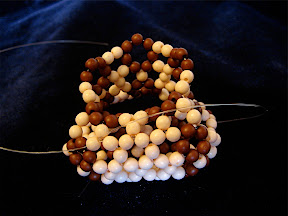
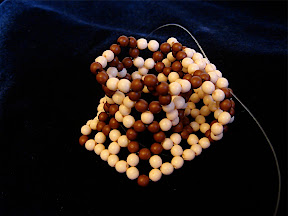
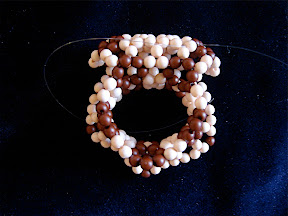
Some more photos for the making of D5h T240 a

The part for the making of inner-rim is the same as that of D5h T240 b.

The making of the out-rim
From Craft Projects


From Craft Projects


From Craft Projects


From Craft Projects


From Craft Projects


From Craft Projects


From Craft Projects


Finished work:

This is the finished beaded structure for the D5h T240 a. This is such a beautiful molecule, different from all of the D5d toroids I made before. It doesn't take me a long time to realize the five pair of pentagons located in the outer-rim can be subjected to the Stone-Wales transformation to get the D5h T240 b shown before.
From Craft Projects


From Craft Projects


From Craft Projects

Monday, December 4, 2006

Chiral T240 belonging to C5 point group

I have managed to make the chiral isomer of T240 (D5h) by shifting the pentagons on the outer rim by one bead. Unfortunately, I was unable to put the beads into a complete torus due to the huge strain energy for this structure. The stable chiral forms of T240 originating from the isomer with D5h point group do not exist! It is quite amazing it is possible to get a first order approximation for the geometry and stability of carbon spheroids or toroids by using molecular beadings. But the price to pay is that you need to spend several hours on the beadings for a single structure.

Previously, I have made two D5h T240 which can be converted into each other by Stone-Wales transformation. But, according to Ihara's paper, there seems to be another kind of T240 isomer which can be generated by moving ten pentagons on the outer rim to the mid-edge position (i.e. shifting 36 degree about z-axis). I am not sure about the stability of this structure. But since the outer-rim pentagons and inter-rim heptagons are arranged in the staggered pattern, I suspect the strain energy for this type of structure is large.

Sunday, December 3, 2006

Another kind of T240

There are many different types of T240. Previously, the three isomers I have shown all have the same inner rim configuration, but with different arrangement in the pentagon distribution on the outer rim. Here I give another structure of T240 with different inner rim configuration. I.e. the heptagons have different spatial locations.

From The Beaded Mo...


Side view:
From The Beaded Mo...

Wednesday, November 29, 2006

Three Carbon 240 isomers: T240

I found it is also easier to see the difference between these three isomers from a different view angle. Here is the side view of the previous three isomers

From The Beaded Mo...

Monday, November 27, 2006

Larger Beaded Toroids: Carbon 240

Here are another examples of beaded toroids, C240. These two structures contain 360 beads each, thus 360 CC bonds. The details of construction are pretty complicated. At present time, I will only show the pictures for the finished structures first.