
Showing posts with label Conference. Show all posts
Showing posts with label Conference. Show all posts
Wednesday, July 30, 2014
Workshop at BCCE, Grand Valley State Univ.
I will give one more workshop in the 2014 Biennial Conference on Chemical Education
which is hosted by the Grand Valley State Univ, Michigan next week.
My workshop is arranged in the afternoon (2:00-5:00PM) of Aug. 4.
 It is free. Hopefully, I brought enough beads with me for every participant.


Wednesday, May 9, 2012
Zometool models at the Quasicrystal international conference
The newest Nobel laureate in Chemistry, D. Shechtman, was invited to Taiwan to participate a quasicrystal international conference held in the National Taipei University of Technology (May 7-9), a university very close to the National Taiwan University where I am working.
Yuan-Chia, Qian-Rui, and Hsin-Yu moved the two large zometool models, a 3D quasicrystal consisting of two types of golden rhombohedra (prolate and oblate) and a six-layer carbon onion (C20, C80, C180, C320, C500, and C720), to the conference's lobby area. Most participants seem to enjoy these two types of quasicrystal models, cluster and tiling, a lot.
 Prof. Shechtman took a picture of me in front of the zometool model of carbon onion.

I also gave Prof. Shechtman a bead model of high-genus fullerene, a topologically nontrivial quasicrystal :-), as a gift.


Yuan-Chia, Qian-Rui, and Hsin-Yu moved the two large zometool models, a 3D quasicrystal consisting of two types of golden rhombohedra (prolate and oblate) and a six-layer carbon onion (C20, C80, C180, C320, C500, and C720), to the conference's lobby area. Most participants seem to enjoy these two types of quasicrystal models, cluster and tiling, a lot.


I also gave Prof. Shechtman a bead model of high-genus fullerene, a topologically nontrivial quasicrystal :-), as a gift.


Friday, May 4, 2012
Workshop in Rome (ICCE & ECRICE)

I was invited to give a workshop, An exploration of molecular shape through mathematical beading, in the 22th International Conference on Chemical Education (ICCE) and 11th European Conference on Research in Chemical Education (ECRICE) which will be held in Rome, 15-20 July 2012. Check the website here www.iccecrice2012.org for the detailed schedule.
AN EXPLORATION OF MOLECULAR SHAPE THROUGH MATHEMATICAL BEADING
Chern Chuang, Chia-Chin Tsoo, Bih-Yaw Jin
Department of Chemistry, National Taiwan University, Taipei, Taiwan;
National Center for High-Performance Computing, Hsin-Chu, Taiwan; R.O.C.
E-mail: byjin@ntu.edu.tw
A few years ago, we discovered that beading an old and traditional craft could be applied systematically to construct faithful three-dimensional molecular shapes of fullerenes and various kinds of complicated graphitic materials including Platonic solids, C60, higher fullerenes, carbon nanotubes, nanotori, nanohelices, high-genus fullerenes, singly-, and triply-periodic minimal surfaces.1-3 Unlike the standard molecular physical model, chemical bonds are represented by beads explicitly, while atoms are not shown in a bead model. The hard-sphere repulsion among beads in a bead model effectively mimic the repulsion between different chemical bonds in a molecule. Thus, the molecular shape of fullerenes can be faithfully modelled by beading technique.
In this workshop, we will show participants how to construct systematically molecular models of fullerenes with beads and how to interpret correctly microscopic meaning of these bead models. Particularly, participants will learn simple beading techniques and build bead models of a dodecahedron and a truncated icosahedron, which are C20 and C60 respectively.
1. Chuang, C.; Jin, B.-Y.; Tsoo, C.-C.; Tang, N. Y.-Wa; Cheung, M. P. S.; Cuccia, L. A., J. Chem. Edu 2012 , 89, 414–416.
2. Chuang, C.; Jin, B.-Y.; Tsoo, C.-C., Proceedings of Bridges: Mathematics, Music, Art, Architecture, Culture, 2011, 523-526.
3. The beaded molecules blog: http://thebeadedmolecules.blogspot.com/.
Monday, November 14, 2011
Clathrate cluster
I bought some more green rice-shape beads last week and managed to finish this interesting clathrate cluster of 60 dodecahedra in the last weekend. One can still see deformation of many dodecahedra in this clathrate cluster though.


Monday, August 8, 2011
Two tiny T120 made by Laura Shea
Laura Shea showed me these two beautiful T120 made of tiny crystal beads in the Bridges conference. They are so small. You can really wear these two carbon nanotori as earrings.


Sunday, July 31, 2011
Bridges 2011
I gave a talk this morning on the designing sculpture inspired by high-genus fullerenes with mathematical beading (pdf file) in the Bridges conference (Coimbra, Portugal).

Here are some bead models I brought to this meeting. These include three large pieces (a dodecahedra, a tetrahedron, and a trefoil knot), four TCNTs (120, 140, 240), and around 25 C60s.


Here are some bead models I brought to this meeting. These include three large pieces (a dodecahedra, a tetrahedron, and a trefoil knot), four TCNTs (120, 140, 240), and around 25 C60s.

Sunday, December 12, 2010
My C168
I have made only one beaded C168, which I gave to Dirk Huylebrouck, a math professor in the department of architecture in Belgium, at the Bridges conference this summer. I took the following photo of this bead model at the Hotel in Pecs, Hungary. I am thinking about making another one, maybe this time with giant beads just like Mr. Horibe has used. Unlike Mr. Horibe, I prefer using different colors for nonhexagons. In this structure, all heptagons are in purple beads. One can easily see that these heptagons are separated by on beads (carbon carbon bonds). In this sense, we can call C168 is the buckyball in the hyperbolic space.

Another two photos that contains more bead models I brought to Bridges conference.


Many of these beadworks are given away as souviners for other attendee. The helically coiled carbon nanotube is given to Laura Shea and the high-genus fullerene is to M. Longuet-Higgins. Toroidal carbon nanotube (T120) with 120 carbon atoms or 180 beads (cat-eye stons) is given away to G. Hart. T120 is made by Chern Chuang. All other small beaded balls are gone too. Many of these small beaded balls are made by Q.-R. Huang. The only three left is the bead models for the P-type triply periodic minimal surface, Shoen's I-WP surface and the trefoil knot, respectively.

Another two photos that contains more bead models I brought to Bridges conference.


Many of these beadworks are given away as souviners for other attendee. The helically coiled carbon nanotube is given to Laura Shea and the high-genus fullerene is to M. Longuet-Higgins. Toroidal carbon nanotube (T120) with 120 carbon atoms or 180 beads (cat-eye stons) is given away to G. Hart. T120 is made by Chern Chuang. All other small beaded balls are gone too. Many of these small beaded balls are made by Q.-R. Huang. The only three left is the bead models for the P-type triply periodic minimal surface, Shoen's I-WP surface and the trefoil knot, respectively.
Tuesday, November 2, 2010
Photos from ICCE


Saturday, August 14, 2010
A few pictures from my workshop at ICCE
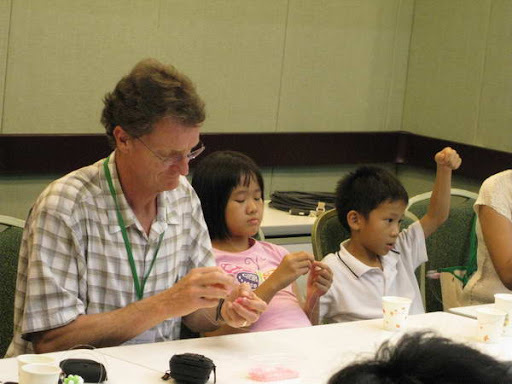
I gave a three-hour workshop, "Chemistry, Geometry and Art", at the 21st International Conference on Chemical Education at the Taipei International Convention Center. I made a 30-min introduction to the background information (slides) first, and then let all participants to work on two projects: C20 and C6o.
People seem to have fun in this workshop.


People seem to have fun in this workshop.


Beaded Car Seat
I took a taxi to the Taipei International Convention Center for my workshop for the ICCE, I found this beaded seat cover in the back seat of the taxi. It is made by the standard right-angle weave with bean-shaped beads.


Beads for the workshop
I bought 15 packages of 10mm beads (about 10,000 beads) for the workshop of ICCE. Qian-Rui Huang and I have also made many bead models of C60 (more than 20 in total). In addition, I have also made some beaded C70s and C80s. Most of them have been given away to the participants of this conference as souvenirs.


Saturday, July 31, 2010
Slides of my talk at Bridges 2010
I just uploaded the slides of my talk to google doc for anyone who is interested in this subject: pdf.
Monday, July 26, 2010


Friday, July 23, 2010
Bead models for Bridges 2010
Here are models I bring with me for the Bridges conference in Pecs, Hungary.


Subscribe to:
Posts (Atom)