Showing posts with label Spiral Codes. Show all posts
Thursday, January 3, 2013
Tetrahedral C28 and related structures
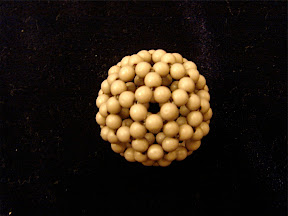
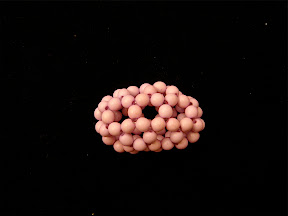
There are only three tetrahedral fullerenes with number of carbon atoms less than that of buckyball. They are C28, C40, and C44, respectively. The spiral code for the smallest tetrahedral fullerene, C28, is [1 2 3 5 7 9 10 11 12 13 14 15]. Following this code, we can easily make its bead model using the standard figure-eight stitch. We can see that, in this molecule, there are 12 pentagons, 3 in a group located at a vertex, and 4 hexagons located on the four faces of the tetrahedron. If we replace these pentagons by heptagons, we get a tetrapod-like structure, in which tri-pentagon vertices become tri-heptagon necks as shown in the following figure.
Using these tetrapods as building blocks, we can get the following diamond-like structure. In fact, this is exactly the structure Mr. Horibe put in the postcard. OK, if we start from other tetrahedral fullerenes such as C40 and C44, we can find out a lot more diamond-like structures.
Friday, November 9, 2012
Two artworks for the Mathematical Exhibition of Joint Mathematical Meeting
Chern and I submitted two artworks to the Joint Mathematical Beading, which were accepted today:
1.
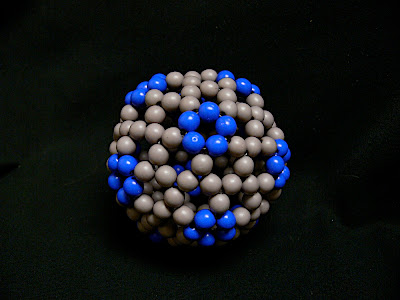
Super Buckyball of Genus 31
2. Beaded Hilbert Curve, step two
In addition to the beadworks we submitted, we also noticed five Platonic bead models made by Ron Asherov. His bead models have multiple beads in an edge, which are similar to our works a few years ago. I labeled this type of bead models with Edge with Multiple Beads, where you can find all the posts. He doesn't seem to know our works along this direction, though.
He also mentioned that the Nylon string passes adjacent edges exactly once with carefully chosen path of string, which is simply the consequence of Hamiltonian path on the dual graph of the corresponding Platonic solids. We can view the whole beading process as a path through the face of polyhedron. Thus if there exists a Hamiltonian path through each face once (Hamiltonian path for the dual polyhedron), then the Nylon string will go through each beads exactly twice and only twice. Of course, you can also say the Nylon string will go through the adjacent edges exactly once. They are the same thing.
Here is a model made by Chern Chuang almost five years ago:
I was quite surprised by its rigidity when Chern showed me this model. At that time, people questioned me about the meaning of beads. I told some of my colleagues that spherical beads represent chemical bonds instead of atoms. Atoms are not shown in the bead model explicitly, instead, they are located at somewhere three beads meet. Most chemists feel uncomfortable with this connection. So Chern and I tried try to explore with the shape of beads and multiple beads and hope that they can better represent the shape of chemical bonds. So that is why we have these models in which multiple beads represent an edge.
But now, I have the valence sphere model of chemical bond as the theoretical foundation of bead models. Spherical beads are in fact the simplest possible approximation of electron pairs, in accord with the principle of Occam's razor. So to build a model of a molecule with only beads and strings is equivalent to performing a molecular analogue computation with beads. The result of computation is the approximate electron density of the corresponding molecule without referring to the Schrödinger equation or atomic orbitals (this is the comment I got from Prof. H. Bent). I have written an article on the connection between bead models and valence sphere model in Chinese for September issue of Science Monthly (科學月刊). I think I should write something about the molecular analogue computation with beads.
Of course, what I am saying above is to view bead models as molecular models. Results of mathematical beading do not need to have any connection to the molecular world. For instance, the beaded Hilbert curve accepted by the JMM mathematical art exhibition is a good example.
2. Beaded Hilbert Curve, step two
In addition to the beadworks we submitted, we also noticed five Platonic bead models made by Ron Asherov. His bead models have multiple beads in an edge, which are similar to our works a few years ago. I labeled this type of bead models with Edge with Multiple Beads, where you can find all the posts. He doesn't seem to know our works along this direction, though.
He also mentioned that the Nylon string passes adjacent edges exactly once with carefully chosen path of string, which is simply the consequence of Hamiltonian path on the dual graph of the corresponding Platonic solids. We can view the whole beading process as a path through the face of polyhedron. Thus if there exists a Hamiltonian path through each face once (Hamiltonian path for the dual polyhedron), then the Nylon string will go through each beads exactly twice and only twice. Of course, you can also say the Nylon string will go through the adjacent edges exactly once. They are the same thing.
Here is a model made by Chern Chuang almost five years ago:
I was quite surprised by its rigidity when Chern showed me this model. At that time, people questioned me about the meaning of beads. I told some of my colleagues that spherical beads represent chemical bonds instead of atoms. Atoms are not shown in the bead model explicitly, instead, they are located at somewhere three beads meet. Most chemists feel uncomfortable with this connection. So Chern and I tried try to explore with the shape of beads and multiple beads and hope that they can better represent the shape of chemical bonds. So that is why we have these models in which multiple beads represent an edge.
But now, I have the valence sphere model of chemical bond as the theoretical foundation of bead models. Spherical beads are in fact the simplest possible approximation of electron pairs, in accord with the principle of Occam's razor. So to build a model of a molecule with only beads and strings is equivalent to performing a molecular analogue computation with beads. The result of computation is the approximate electron density of the corresponding molecule without referring to the Schrödinger equation or atomic orbitals (this is the comment I got from Prof. H. Bent). I have written an article on the connection between bead models and valence sphere model in Chinese for September issue of Science Monthly (科學月刊). I think I should write something about the molecular analogue computation with beads.
Of course, what I am saying above is to view bead models as molecular models. Results of mathematical beading do not need to have any connection to the molecular world. For instance, the beaded Hilbert curve accepted by the JMM mathematical art exhibition is a good example.
Friday, June 1, 2012
C76
There are two isomers of C76 that satisfy the isolated pentagon rule (IPR). Here is the bead model for C76 with Td symmetry just constructed by Yuan-Chia Fan.
The spiral codes for these two isomers of C76 are
C76:1 [1 7 9 11 13 18 26 31 33 35 37 39] D2
C76:2 [1 7 9 12 14 21 26 28 30 33 35 38] Td
C76:1 [1 7 9 11 13 18 26 31 33 35 37 39] D2
C76:2 [1 7 9 12 14 21 26 28 30 33 35 38] Td
Sunday, April 15, 2012
Three Kekule structures of C60
D. Vukicevic and M. Randic have figured out all possible distinct resonance (or Kekule)
structures a few years ago. According them,
buckminsterfullerene has 12500 Kekule structures grouped in 158 isomorphic classes. They also give
a complete list of all these 158 non-isomorphic Kekuke structures in a recent paper
entitled "Detailed Atlas of Kekulé Structures of the Buckminsterfullerene", in the book,
"The Mathematics and Topology of Fullerenes".
This is very convenient if we want to make any particular resonance form of C60. We can simply look at the Schlegel diagrams given in this paper, and pay attention to the single and double bond pattern as we bead. Here are three bead models for Kekule structures No. 134, 135 and 136 as shown in their paper.
Wednesday, October 12, 2011
C70 beading procedure
C70. Point group D5h.
Shape: like a Rugby ball.
60 8mm red beads and 45 8mm white beads are used.
Ring spiral: [1 7 9 11 13 15 27 29 31 33 35 37]


The red and green parts of spiral are exactly the same as the spiral of C60. The orange part of the spiral is a ring of 10 hexagons inserted in between two hemispheres of C60! Of course, instead of inserting one ring of 10 hexagons, one can do it repeatedly to get different length of endcapped carbon nanotubes! So C70 is the shortest endcapped carbon nanotube.
Note also that the blue circles in this graph are not beads! Beads represent edges or chemical bonds of fullerenes.
I made a few bead models for Prof. Gillespie, who proposed the the famous VSEPR method, last week. This C70 model is one of them.
Shape: like a Rugby ball.
60 8mm red beads and 45 8mm white beads are used.
Ring spiral: [1 7 9 11 13 15 27 29 31 33 35 37]


The red and green parts of spiral are exactly the same as the spiral of C60. The orange part of the spiral is a ring of 10 hexagons inserted in between two hemispheres of C60! Of course, instead of inserting one ring of 10 hexagons, one can do it repeatedly to get different length of endcapped carbon nanotubes! So C70 is the shortest endcapped carbon nanotube.
Note also that the blue circles in this graph are not beads! Beads represent edges or chemical bonds of fullerenes.
I made a few bead models for Prof. Gillespie, who proposed the the famous VSEPR method, last week. This C70 model is one of them.
Friday, October 7, 2011
C60 beading procedure
I took a few photos for making bead model of C60. This will be helpful for learning the so-called figure-eight stitch (or right-angle weave) and the beading rule of C60 I mentioned before.
South hemisphere:

North hemisphere:


* General instruction:
1. There are 32 polygons consisting of 12 pentagons and 20 hexagons in a C60.
2. Every pentagon is separated from neighbored pentagons by eactly one CC bond.
3. If we choose one color of beads for pentagons and the other for the rest, one would find hexagons made of two colors alternatively.
4. It is better to view C60 as a sphere consisting of six layers of polygonal strips. For the south semisphere, they are basically a pentagon for the south pole, five hexagons next, 10 polygons consisting of 5 pentagons and 5 hexagons. Reverse the beading sequence, one gets the north semisphere. (This is what people called the spiral code.)
5. One has to check how many beads of group one wants to create in the next step. Some beads are already done, so one has to thread the fishing cord through these beads first, then add the remaining beads through the other end of fishing cord, and finally, form the n-bead group by threading the fishing cord through the last bead just added along the opposite direction.
Of course, one should always check the sequence of colors of beads one is going to bead and make sure that they satisfy the color coding mentioned in 3.
For beginners, this is usually the hardest part and mistakes occur easily. Most often, wrong number of beads are added or some beads are not threading through first. But, if one can pay attention to the number of beads in the next group one is going to make, it should be trivial to figure out how many beads are already there and how many more one should add.
If two colors of beads are used, one can simply pay attention to color. Beading process for a C60 becomes trivial.
The beading procedure can be summarized by the spiral code on the following Schlegel diagram of C60. For C60, it is [1 7 9 11 13 15 18 20 22 24 26 32], which is essentially the positions of pentagons along the spiral path starting from south pole to the north pole. It is not hard to find this code is the only information we need to create a bead model of C60. Similarly, one can create any other cage-like fullerene by its spiral code only if the fullerene possesses it.
A list of fullerenes up to 100 carbon atoms is given in the appendix of the book "An Atlas of Fullerenes" by P. W. Fowler and D. E. Manolopoulos. So one can create any fullerene easily by following its spiral code. The shape of the resulting bead model is basically consistent with the corresponding fullerene.
South hemisphere:

North hemisphere:


* General instruction:
1. There are 32 polygons consisting of 12 pentagons and 20 hexagons in a C60.
2. Every pentagon is separated from neighbored pentagons by eactly one CC bond.
3. If we choose one color of beads for pentagons and the other for the rest, one would find hexagons made of two colors alternatively.
4. It is better to view C60 as a sphere consisting of six layers of polygonal strips. For the south semisphere, they are basically a pentagon for the south pole, five hexagons next, 10 polygons consisting of 5 pentagons and 5 hexagons. Reverse the beading sequence, one gets the north semisphere. (This is what people called the spiral code.)
5. One has to check how many beads of group one wants to create in the next step. Some beads are already done, so one has to thread the fishing cord through these beads first, then add the remaining beads through the other end of fishing cord, and finally, form the n-bead group by threading the fishing cord through the last bead just added along the opposite direction.
Of course, one should always check the sequence of colors of beads one is going to bead and make sure that they satisfy the color coding mentioned in 3.
For beginners, this is usually the hardest part and mistakes occur easily. Most often, wrong number of beads are added or some beads are not threading through first. But, if one can pay attention to the number of beads in the next group one is going to make, it should be trivial to figure out how many beads are already there and how many more one should add.
If two colors of beads are used, one can simply pay attention to color. Beading process for a C60 becomes trivial.
The beading procedure can be summarized by the spiral code on the following Schlegel diagram of C60. For C60, it is [1 7 9 11 13 15 18 20 22 24 26 32], which is essentially the positions of pentagons along the spiral path starting from south pole to the north pole. It is not hard to find this code is the only information we need to create a bead model of C60. Similarly, one can create any other cage-like fullerene by its spiral code only if the fullerene possesses it.
A list of fullerenes up to 100 carbon atoms is given in the appendix of the book "An Atlas of Fullerenes" by P. W. Fowler and D. E. Manolopoulos. So one can create any fullerene easily by following its spiral code. The shape of the resulting bead model is basically consistent with the corresponding fullerene.
Tuesday, August 31, 2010
Spiral codes in "An atlas of fullerenes"
I finally got my own copy of Fowler and Manolopoulos's "An Atlas of Fullerenes" from the MIT coop at Kendall square last weekend. In the appendix of this book, there is a complete list of spiral codes for fullerenes with less or equal than 100 carbon atoms. So one can simply follow the spiral code to create the physical model of corresponding fullerene. More importantly, if we followed the simple weaving rule, no other information except the spiral code is required to make the correct physical model!
I made the only isomer of C72 and C74, which satisfies the IPR (isolated-pentagon rule) requirement, based on the spiral codes listed in the appendix immediately when I was back to Taiwan yesterday. Just as expected, the bead model of C72 has D6d symmetry, and the bead model of C74 has D3h symmetry as shown in the book.
Spiral codes:
C72: 1 7 9 11 13 18 22 24 27 34 36 38
C74: 1 7 9 11 14 23 26 28 30 32 35 38

I made the only isomer of C72 and C74, which satisfies the IPR (isolated-pentagon rule) requirement, based on the spiral codes listed in the appendix immediately when I was back to Taiwan yesterday. Just as expected, the bead model of C72 has D6d symmetry, and the bead model of C74 has D3h symmetry as shown in the book.
Spiral codes:
C72: 1 7 9 11 13 18 22 24 27 34 36 38
C74: 1 7 9 11 14 23 26 28 30 32 35 38

Saturday, February 13, 2010
Wednesday, July 2, 2008
T120 weaving code
Here is the weaving procedure I used for creating T120 toroidal nanotube.
This code is resulting from my experience. The details may vary from time to time.

As I have addressed before, I separate the weaving procedure of a torus into two steps: in the first step, we weave the inner part of the torus; and in the second step, we weave the outer part. It is obvious why the inner part has to be built first, otherwise it will become difficult to weave the inner part if we weave from outer part inward.
You may wonder why I didn't follow the latitude completely for T120. The reason is that I want to avoid the the awkward position that may arise if I follow the latitude from inner part. If I weave all ten heptagons at the beginning, later on, I still need to return back the connected region between hexagons and heptagons. Usually, it is quite difficult to do that if I use 4mm beads. For larger beads, it may be ok to weave completely along latitude coordinate.

This code is resulting from my experience. The details may vary from time to time.

As I have addressed before, I separate the weaving procedure of a torus into two steps: in the first step, we weave the inner part of the torus; and in the second step, we weave the outer part. It is obvious why the inner part has to be built first, otherwise it will become difficult to weave the inner part if we weave from outer part inward.
You may wonder why I didn't follow the latitude completely for T120. The reason is that I want to avoid the the awkward position that may arise if I follow the latitude from inner part. If I weave all ten heptagons at the beginning, later on, I still need to return back the connected region between hexagons and heptagons. Usually, it is quite difficult to do that if I use 4mm beads. For larger beads, it may be ok to weave completely along latitude coordinate.

Tuesday, July 1, 2008
Wednesday, April 16, 2008
Sunday, December 31, 2006
More measurements on C80
I have perfomed more measurements of length for weaving C80.
The scaling factor are calculated as follows
80:1 105/96=1.09
80:2 107/96=1.11
80:3 106/96=1.10
80:4 108/96=1.13
80:5 105/96=1.09
80:6 105/96=1.09
By the way, if anyone would like to build the seven isomers of C80, here are the spiral codes for all of them
80:1 1 7 9 11 13 15 28 30 32 34 36 42
80:2 1 7 9 11 13 18 25 30 32 34 36 42
80:3 1 7 9 11 14 22 27 30 34 36 38 40
80:4 1 7 9 11 14 23 28 30 33 35 37 39
80:5 1 7 9 12 14 20 26 28 32 34 39 42
80:6 1 7 10 12 14 19 26 28 32 34 39 42
80:7 1 8 10 12 14 16 28 30 32 34 36 42
The resulting beaded C80's are given in the figure below.
The scaling factor are calculated as follows
80:1 105/96=1.09
80:2 107/96=1.11
80:3 106/96=1.10
80:4 108/96=1.13
80:5 105/96=1.09
80:6 105/96=1.09
By the way, if anyone would like to build the seven isomers of C80, here are the spiral codes for all of them
80:1 1 7 9 11 13 15 28 30 32 34 36 42
80:2 1 7 9 11 13 18 25 30 32 34 36 42
80:3 1 7 9 11 14 22 27 30 34 36 38 40
80:4 1 7 9 11 14 23 28 30 33 35 37 39
80:5 1 7 9 12 14 20 26 28 32 34 39 42
80:6 1 7 10 12 14 19 26 28 32 34 39 42
80:7 1 8 10 12 14 16 28 30 32 34 36 42
The resulting beaded C80's are given in the figure below.
Friday, December 29, 2006
Supplementary Constraint in Using Spiral code
Is the sequence as given by the spiral code enough for the building of beaded fullerene? Well, not really, you need to have some extra conditions to get the work done. For instance, the spiral code for the dodecahedron is 1 2 3 4 5 6 7 8 9 10 11 12, which gives the spiral sequence 555555555555 of 12 pentagons. Here I will give the detailed procedure for weaving a dodecahedron based on this sequence.
The weave of our beaded molecules can be done easily with stiff thread along. I found that there is no need to use needles. So the supply we need is just beads and a wheel of lines for threading. With a simple counting, we need at least 30 (20*3/2 = 30) beads (4mm) and 50 cm of stiff thread (0.3 mm). Work clockwise or counterclockwise according to the spiral code.
Step 1: Using one end of the line. String on 5 beads into the thread, letting them fall to the center of line. Take the other end of the line and cross it back through the last bead. Pull tight to form the first group with 5 beads. If necessary, reposition it toward the middle of the line.
Step 2: Add another 4 beads into one end of line in your right hand. Pass the other end of thread (thread in your left hand) to the nearest bead in the previous group. Cross the thread in you left hand back through the last bead you just added and pull tight. A new 5-bead group should result.
Step 3: Repeat step 2 until the whole sequence of spiral code is finished, the beaded molecule will appear.
As you continue working on the beaded molecule, you will notice that it tends to curve slightly when a new pentagon is added.
When repeating the step 2, the number of beads need to be added to the thread in your right hand and also the beads in the previous group need to stitched though by the thread in you left hand can change. An experienced beader can figure out this number easily as the beading process continues. Chemists may take the advantage their chemical knowledge to decide how many beads in the neighbor group you need to stitch through with the thread in your left hand. Basic criteria is that you need to stitch through all of the beads (chemical bonds) belong to the same carbon atoms.
The weave of our beaded molecules can be done easily with stiff thread along. I found that there is no need to use needles. So the supply we need is just beads and a wheel of lines for threading. With a simple counting, we need at least 30 (20*3/2 = 30) beads (4mm) and 50 cm of stiff thread (0.3 mm). Work clockwise or counterclockwise according to the spiral code.
Step 1: Using one end of the line. String on 5 beads into the thread, letting them fall to the center of line. Take the other end of the line and cross it back through the last bead. Pull tight to form the first group with 5 beads. If necessary, reposition it toward the middle of the line.
Step 2: Add another 4 beads into one end of line in your right hand. Pass the other end of thread (thread in your left hand) to the nearest bead in the previous group. Cross the thread in you left hand back through the last bead you just added and pull tight. A new 5-bead group should result.
Step 3: Repeat step 2 until the whole sequence of spiral code is finished, the beaded molecule will appear.
As you continue working on the beaded molecule, you will notice that it tends to curve slightly when a new pentagon is added.
When repeating the step 2, the number of beads need to be added to the thread in your right hand and also the beads in the previous group need to stitched though by the thread in you left hand can change. An experienced beader can figure out this number easily as the beading process continues. Chemists may take the advantage their chemical knowledge to decide how many beads in the neighbor group you need to stitch through with the thread in your left hand. Basic criteria is that you need to stitch through all of the beads (chemical bonds) belong to the same carbon atoms.
Thursday, December 28, 2006
Spiral code for creating fullerenes
As I have mentioned that the details of the beading procedure for creating a fullerene molecule describable by a spiral should be completely determined by the sequence of pentagons and hexagons. Once this sequence is given, then we can just carry out the weaving process by making the 5 or 6-bead group using the RAW according the recipies. Sound simple, right. But we still need to know the sequence in order to make the fullerene we intend to create. Fortunately, the complete list of all possible isomers for fullerenes in the range C20 to C50 and isolated-pentagon isomers of fullerenes in the range C60 to C100 are tabulated in Fowler's "An Atlas of Fullerenes". Instead of giving the whole sequence of 5- and 6-gons. Fowler also gives another simplified notation for the sequence of 5- and 6-gons in the spiral. Since there are exactly twelve pentagons in a fullerene, and the others are hexagons, therefore we only need to know the positions for the pentagons in the spiral.
Here I will illustrate his notation with two simple examples. The first one is an isomer of C80, Fowler's 80:7 isomer (the 7th isomer out 7 isolated-pentagon isomers of C80), with the spiral code, 1 8 10 12 14 16 28 30 32 34 36 42. According this spiral code, I have to make a pentagon first, then 6 hexagons, and then a pentagon, hexagon, pentagon, and so on, in a clockwise spiral. Finally a C80 is created. In the process of making this fullerene, I don't need to worry about the connectivity or geometry, the resulting beaded C80 is in good agreement with the actual geometry of C80 due to the repulsion between different beads.
Another one I made is isomer 50:24 with spiral code 1 2 3 4 7 12 17 22 24 25 26 27, which is an isomer of C50. The shape of this isomer looks like a bean or cocoon.
Here I will illustrate his notation with two simple examples. The first one is an isomer of C80, Fowler's 80:7 isomer (the 7th isomer out 7 isolated-pentagon isomers of C80), with the spiral code, 1 8 10 12 14 16 28 30 32 34 36 42. According this spiral code, I have to make a pentagon first, then 6 hexagons, and then a pentagon, hexagon, pentagon, and so on, in a clockwise spiral. Finally a C80 is created. In the process of making this fullerene, I don't need to worry about the connectivity or geometry, the resulting beaded C80 is in good agreement with the actual geometry of C80 due to the repulsion between different beads.
| From Craft Projects |
Another one I made is isomer 50:24 with spiral code 1 2 3 4 7 12 17 22 24 25 26 27, which is an isomer of C50. The shape of this isomer looks like a bean or cocoon.
| From Craft Projects |
Subscribe to:
Posts (Atom)