
Showing posts with label Polyhedron. Show all posts
Showing posts with label Polyhedron. Show all posts
Friday, December 20, 2013


Friday, December 6, 2013

Tuesday, March 20, 2012
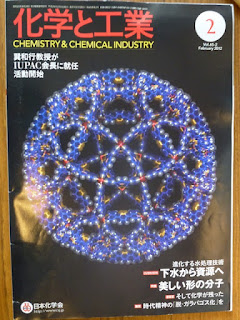
形狀美麗的分子(Chemistry & Chemical Industry, Vol. 62, 2012)
Prof. Sonoda (園田高明) of Kyushu University sent me a special issue on "Beautifully Shaped Molecules" of "Chemistry & Chemical Industry" published by Japanese Chemical Society. There are five articles by famous Japanese chemists in this issue. The photos I showed here are from an article on "Self-Assembled Polyhedra" (my translation based on the Kanji in the title, I don't know Japanese, though) by Makato Fujita (藤田 誠) of Tokyo University.


Sunday, February 20, 2011
Chiral cube - the generalized Goldberg polyhedra
Chern Chuang discovered that one can generalize the Goldberg polyhedra to those polyhedra consisting of square grids, instead of triangular or hexagonal grids. Accordingly, the following polyhedron can be classified as the generalized Goldberg vector (3,1); while the cuboctahedron and rombicuboctahedron as shown in the previous posts can be classified as (1,1) and (2,0), respectively.


Tuesday, February 15, 2011

Monday, January 24, 2011
C960 - Goldberg vector (4,4)
The number of atoms in a Goldberg polyhedron is given by the formula N=20(h2 + hk + k2). If h=k, one has N=60*h2=60*42 = 960 atoms in (4,4)-Goldberg polyhedron.


Saturday, December 18, 2010

Friday, December 17, 2010


Monday, December 13, 2010
Goldberg Polyhedron (5,0)
Here is the bead model for the Goldberg polyhedron (5,0) The number of vertices in this model is 20(52) =500. The number of beads (6mm, faceted) used is 500*3/2=750.


Friday, December 10, 2010
C540
I made another giant fullerene with Goldberg vector (3,3) last week.
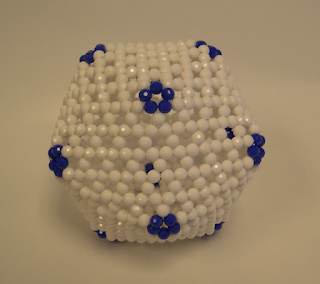
Goldberg vector (3,3) gives the position where to put the next pentagon. With this in mind, one can create easily any fullerene specified by the Goldberg vector (i,j).


Goldberg vector (3,3) gives the position where to put the next pentagon. With this in mind, one can create easily any fullerene specified by the Goldberg vector (i,j).

Friday, November 26, 2010
Fullerenes belonging to icosahedral group
It is straightforward to make bead models for higher fullerenes with icosahedral symmetry. The simplest way is to use the Goldberg vector (see the following figure) to specify the relative position between two pentagons. Goldberg vector is very similar to the chiral vector used for defining carbon nanotubes.
Suppose we have the first pentagon located at orgin, (0,0), then we can ask where the next pentagon can we put? The answer is that any coordinate specified by (i,j) as shown in the following figure gives a unique fullerene with icosahedral symmetry. For instance, if the next pentagon is located at (i,j)=(1,1), we have a C60. It is not hard to show that the number of carbon atom for the fullerene specified by the Goldberg vector, (i,j), is N=20(i2 + ij + j2).

(Figure 8 in "Jin, B.-Y.*; Chuang, C.; Tsoo, C.-C. “The Wonderful World of Beaded Molecules. 串珠分子模型的美妙世界” CHEMISTRY (The Chinese Chemical Society, Taipei) 2008, 66, 73-92, in chinese.")
A bead model of C60, Goldberg vector (1,1).

Icosahedral fullerene specified by the Goldberg vector (2,1) has 140 carbon atoms. This is the smallest chiral fullerene with icosahedral symmetry.

The following beaded fullerene is specified by (4,0) has 320 carbon atoms.

Suppose we have the first pentagon located at orgin, (0,0), then we can ask where the next pentagon can we put? The answer is that any coordinate specified by (i,j) as shown in the following figure gives a unique fullerene with icosahedral symmetry. For instance, if the next pentagon is located at (i,j)=(1,1), we have a C60. It is not hard to show that the number of carbon atom for the fullerene specified by the Goldberg vector, (i,j), is N=20(i2 + ij + j2).

(Figure 8 in "Jin, B.-Y.*; Chuang, C.; Tsoo, C.-C. “The Wonderful World of Beaded Molecules. 串珠分子模型的美妙世界” CHEMISTRY (The Chinese Chemical Society, Taipei) 2008, 66, 73-92, in chinese.")
A bead model of C60, Goldberg vector (1,1).

Icosahedral fullerene specified by the Goldberg vector (2,1) has 140 carbon atoms. This is the smallest chiral fullerene with icosahedral symmetry.

The following beaded fullerene is specified by (4,0) has 320 carbon atoms.

Wooden bead C60
This is a C60 constructed by eaglewood buhdda beads (烏木佛珠). I bought these beads in ChengDu, Sichuang last year.


Monday, June 28, 2010
A dodecahedral ball made with bamboo
Again, I saw this interesting dodecahedral ball in Alberto's living room. He told me that he bought this at Vietnam a few years ago.


A nice glass cuboctahedron
Alberto has this beautiful gass box with cuboctahedral shape in his living room.


Thursday, June 24, 2010

Yet another bead model of rhombicuboctahedron
Another rhombicuboctahedron using beads with long-aspect ratio:


Tuesday, June 15, 2010

Beaded Zongzi
Tomorrow is the Duanwu Festival (端午節), also known as Dragon Boat Festival, a traditional and statutory holiday in China. We eat Zongzi (粽子) during this Festival. Zonzi is a traditional Chinese food, made of glutinous rice stuffed with different fillings and wrapped in bamboo or reed leaves. The shape of zongzi ranges from being relatively tetrahedral in southern China (including Taiwan) to cylindrical in northern China.
It is not a bad idea to make bead model of zonzi. Since there are 12 pentagons in a cage-like fullerene, one has to put three pentagons around each vertex of a tetrahedron.
 [Strange, this post disappear automatically.]

Thursday, April 8, 2010

Tuesday, April 6, 2010
Another set of beaded models of platonic solids
Here is another set of beaded Platonic solids made with the same type of beads.


Subscribe to:
Posts (Atom)