Showing posts with label Zometool. Show all posts

Thursday, October 23, 2014

Evolution of superbuckyballs

Since the last month of 2011, I started to work on the so-called Sierpinski buckyballs or superbuckyballs, which belong to a particular family of fullerenes created by treating C60s as supernodes and carbon nanotubes as superbonds. Using this idea, an unlimited number of hierarchical super-structures of sp2-hybridized (3-coordinated) carbons can be constructed. Before this task was really started, I have managed to build some simpler structures such as super-triangle, super-tetrahedron, and other related structures. With the experience, I firmly believed in the feasibility of creating bead models of much larger superbuckyballs. But it is too tedious to construct bead models for this kind of super-structures, especially the so-called C60xC60, alone. So I designed a modular approach to build these models collaboratively. I told a few chemistry teachers, especially Dr. Chou (周芳妃), at a local high school, The Taipei First-Girl School (TFGH), about this structure. They were glad to try this idea out together. The results are two beautiful superbuckyballs (or C60xC60) made by 6mm and 12 mm beads, respectively. Both of the structures were on public display for the anniversary of TFGH and a simultaneous event of the TFGH's 30-year alumni reunion. Alumni association of TFGH kindly supported the whole project. Dr. Tsoo was one of alumni that year, that was why we got supported from them.
Later on, I made another bead model of C60xC60 for the JMM held in San Diego about two years ago (Jan. 2013). I used the photo of the giant bead model students and I made in the JMM description though. I met Chern (莊宸) in the meeting. We discussed the structural rules for this family of compounds. Particularly, I commented on that the particular model I made cannot be constructed by Zometool. After returning back to Cambridge, MA, Chern solved the problem by carefully puncturing holes along certain symmetry axes in order to be consistent with the Zometool requirements.
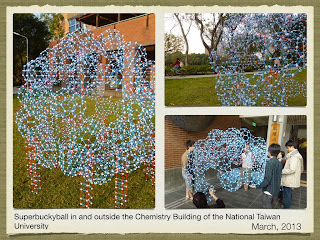
Yuan-Jian Fan (范原嘉) then proved Chern's idea by building a virtual C60xC60 super-buckyball with the zometool construction software, vZome, which was kindly given to us by its author, Scott Vorthmann, a few years ago. With everything ready, a few enthusiastic students from the theoretical chemistry group of the National Taiwan University started to build the first zometool super buckyball after the Chinese new year.

Soon, a number of practical issues on the construction of a real zometool model of C60xC60 super-buckyball appeared. The first issue is the structural stability against gravity. The original neck structures (shortest situations) designed by Chern consisted of a number of octagons were too weak and simply cannot hold the whole structure due to its own weight. Another issue is still weight, without extra stands, the southern hemisphere of super-buckyball constructed by zometool simply cannot hold the northern hemisphere. Finally, how to put those parts on top without scaffold is also a question. All these problems were solved beautifully by Yuan-Jia Fan. Of course, local dealer, Helen Yu, of Zometool in Taiwan is also helpful. She always responded us with the necessary zometool pieces upon our requests in a very short time. So, we can have the first zometool sculpture of C60xC60 erected in the NTU campus around mid-March.
Chern then proposed to Paul Hildebrand to have a family-day activity for the 2013 Bridges which will be held in Enschede that year. Paul agreed to provide us with the necessary materials. At the family day, we got more help from a few Bridges participants and their family members from Taiwan. These included Profs. Liu (劉柏宏) and Tung-Shyan Chen (陳東賢). Without them the final C60xC60 structure couldn't be finished in such a short period.
In addition to the construction of huge zometool superbuckyball, Chern also presented a small bead model to the Bridges meeting as shown in the following pictures based on the same construction rule he designed. Another bead model in his right hand is an edge-elevated dodecahedron assembled from fifty C80s, twenty for the vertices of dodecahedron and thirty for the elevated edges. The idea for making this one is similar to C60xC60. I brought them back to Taiwan and put them on exhibition in the NTU Chemistry Museum for about a year until the last July when Chern got an email from George Hart asking him about the possibility of donating this small C60xC60 model for MoSAIC (Mathematics of Science, Art, Industry, and Culture) traveling exhibition. In the email, George commented on this model as " having the right combination of artistic expression, mathematical content, and practical transportability".

Thursday, March 7, 2013

Superfullerene with zometools

After months of planning, we finally created the zometool model of superfullerene, a giant buckyball consisting of 60 smaller buckyballs.


The main lobby, 勝凱廳, of chemistry department of National Taiwan University.

Sunday, December 30, 2012

國語日報報導 (report from the Mandarin's Daily News)

昨天到科教館參加「探索化學世界」的開幕,碰到不少記者,也是第一次跟那麼多記者講話。國語日報記者陳祥麟與陳壁銘替我跟zometool準晶模型拍了幾張照片,寫了一個有關串珠的報導:

分子結構像串珠 教授動手做模型 (2012/12/30)

I met a few local reporters in the opening ceremony of "The wonderland of chemistry" held in the National Center for Science and Education yesterday. This was the first time I talked to so many reporters. A photographer from the Mandarin Daily News (國語日報), a traditional Chinese children's newspaper published daily in Taiwan (wiki), took a picture of me with the giant Zometool model of quasicrystal hung under the ceiling in the exhibition room. The reporters of the Mandarin Daily News also wrote a report about my bead models in Chinese.

Sunday, December 2, 2012

Bead models and Omnitruncated dodecaplex for Math Education meeting

I had an exhibition for a local meeting on math education held in the math-astronomy building (數學天文館) of the National Taiwan University this weekend. Math-Astronomy building is close to the chemistry building, 積學館, where I am working. But I only have two tables for my beadworks. So I chose a few larger ones for this exhibition. The following pictures of my exhibition were taken from the Facebook of Ms. Helen Yu.
Helen also prepared a giant Zometool model, a 3-meter omni-truncated dodecaplex, for this meeting. More than 10 grad students from the theory group of chemistry department and a few students from the math department participated the final stage of this project one day before the meeting. We faced a number of problems during the construction due to the huge size of the model. It is hard for the model to hold its own weight especially when one tried to build the top first. But eventually, we solved almost all of the problems, except the final piece located at the North Pole of this model. Even though one of students is about 197 cm high, still we couldn't fix that one. Fortunately, it is not easy to notice it. So, we decided to leave it slightly incomplete because the model will be dismantled after a week of display in the mathematics/astronomy building.

Friday, November 16, 2012

The introduction to quasicrystal in Zometool website

I saw a page at zomeool company website about the quasicrystal model made by the zometool. There is a paragraph about the model displayed in the 2nd floor, outside the Pan-Guan Lecture Room of the chemistry departmen, National Taiwan University. My former student, Hsin-Yu Ko, kindly introduced the model to the students from the King David School in Taipei, possibly early last summer.

The history of the zometool model of this quasicrystal is here.

Thursday, November 15, 2012

準晶模型的前世與今生 The evolution of the 3D quasicrystal model

I wrote something in my facebook about the origin of the zometool model of quasicrystal (mainly in Chinese with a little bit English) which my students and I designed and created :

準晶模型的前世與今生 The evolution of the 3D quasicrystal model

Helen Yu, the dealer of zometool in Taiwan, also posted a lot of photos about the reconstruction of this model together with the carbon onion at the National Taiwan Science Education Center here:
Gluing& Hanging Models (Photo Credits)- keeping uploading..

Tuesday, November 6, 2012

Zometool: quasicrystal and carbon onion

National Taiwan Science Education Center (NTSEC, 國立臺灣科學教育館) is going to have new area for the chemistry demonstration. They also decided to hang the two zometool models, carbon onion and quasicrystal, we designed, constructed and donated (Chemistry department, National Taiwan University). However, the original structures, particularly the quasicrystal, are not stable enough to be hung under the ceiling. So we decided to strengthen the original quasicrystal model by adding a stick along the short diagonal of each face. These sticks are blue, which, I believe, can make the the whole model much more colorful. Additionally, my students have also carefully glued each part together. It takes a lot of work. So, the whole project is still unfinished yet.
From left to right: 郭岷翔,范原嘉(Yuan-Jia, Fan),詹欣穆,秦逸群,黃泓穎 (photo by Helen Yu)

Monday, August 6, 2012

Quasicrystal zometool model donated to the National Taiwan Science Education Center (NTSEC, 國立臺灣科學教育館).

A few months ago, I decided to donate the two zometool models of quasicrystal and six-layer carbon onion to the National Taiwan Science Education Center (NTSEC, 國立臺灣科學教育館). Finally, Hsin-Yu, Yuan-Chia and some other students of mine moved these two models to the NESEC last week.

Originally, due the the tight budget, we couldn't really make the complete zometool model of quasicrystal consisting of stellated rhombic triacontahedra up to the second level. Fortunately, Ms. Helen Yu, the owner of a local Kindergarden, kindly supported us to finish this two-level quasicrystal structure. Here are a few photos from the special activity with kids from the Helen's Kindergarden.

Yuan-Chia and Hsin-Yu explained the construction rules to Kids:

Kids were working on the basic units:


Hsin-Yu, Bang-Rui, Yuan-Chia, I-Chun, and Hsin-Mu took a picture together in front of this beautiful zometool model of quasicrystal:

Friday, May 11, 2012

An old photo from Paul Hildebrandt

I got a nice picture of D. Shechtman with Zometoy from Paul Hildebrandt, President of Zometool Inc:

(NIST, 1985)

Wednesday, May 9, 2012

Zometool models at the Quasicrystal international conference

The newest Nobel laureate in Chemistry, D. Shechtman, was invited to Taiwan to participate a quasicrystal international conference held in the National Taipei University of Technology (May 7-9), a university very close to the National Taiwan University where I am working.
Yuan-Chia, Qian-Rui, and Hsin-Yu moved the two large zometool models, a 3D quasicrystal consisting of two types of golden rhombohedra (prolate and oblate) and a six-layer carbon onion (C20, C80, C180, C320, C500, and C720), to the conference's lobby area. Most participants seem to enjoy these two types of quasicrystal models, cluster and tiling, a lot.
Prof. Shechtman took a picture of me in front of the zometool model of carbon onion.

I also gave Prof. Shechtman a bead model of high-genus fullerene, a topologically nontrivial quasicrystal :-), as a gift.

Monday, November 21, 2011

Quasicrystals with Zometool

Yuan-Chia Fan (范原嘉), Hsin-Yu Ko(柯星宇) and Mu-Chieh Chang (張慕傑) made a beautiful quasicrystal consisting of two types of rhombohedra with zometool last Friday. They put this model in the main lobby of our chemistry department for the alumni reunion last Saturday.
In addition to the tiling approach to the quasicrystal, one also constructs it using the cluster approach. In this sense, the carbon onion we made before is also a quasicrystal.

Originally, we didn't order enough red sticks to connect different shells of this structure. So only a few red sticks are used to hold neighbored Goldberg polyhedra along one five-fold axis (z direction). We now have enough red sticks for all twelve (or six) 5-fold axes emanating from the central dodecahedron (Goldberg vector (1,0)). So libration motion of each shell is quenched.

Yuan-Chia, Hsin-Yu, and Mu-Chieh also designed a wonderful support around pentagon at the bottom to enhance the stability for the this six-layer Goldberg polyhedra.

Friday, July 8, 2011

Carbon onion with zometool

We made a molecular model for the carbon onion consisting of six layers of concentric icosahedral fullerenes: C20, C80, C180, C320, C500, C720. This structure contains about 1820 balls and 2730 sticks. Some more extra sticks are used to connect different layers too.


Wednesday, July 6, 2011

Summer camp 2011

I offered a summer camp (繽紛多彩石墨烯─結構與模型, Amazing graphitic structures or here) on creating structures and models of graphitic materials using a number of different techniques for high-school students in Taichung these few days (7/5-7/7).
Three different techniques we used in this mini-workshop are the mathematical beading (one and half days), modular origami based on PHiZZ units (half day) and zometool (half day).

1. 7/5 morning: Students learned the structures of Platonic solids and created bead models of tetrahedron, cube, dodecahedron (C20), and C24. I found that it is very useful to construct these simple trivalent Platonic solids first using beads with rod-like shape. With this, students can become familiar with the basic technique of right-angle weave.
2. The projects for the 7/5 afternoon is to construct bead models of C60 and C80. Most students can finish these projects in three hours.
3. 7/6 morning: Chern spent an hour to explain the molecular structures with jmol (a powerful program for visualizing any kind of molecular structure) first. Particularly, we use C60, T120 and so on as examples. In the next two hours, students started to make bead model of T120. All students succeeded in making their own beaded T120.
4. 7/6 afternoon: We switched to modular origami using PHiZZ units. The only project for this part is to make a dodecahedron.
5. We planned to build a giant concentered multilayer carbon onion consisting of 6 layer of icosahedral fullerenes using the Zometool tomorrow morning (7/7).


Participants:
1. TAs: Chern Chuang, Yuan-Chia Fan and Qian-Rui Huang.
2. twelve students from Taipei (2), Taichung (5), Changhua (4), and Tainan (1)..

Here are a few photos from the camp.


Two T120s that were constructed by students: