Showing posts with label G-surface. Show all posts

Tuesday, March 25, 2025

舍恩 G 曲面富勒烯串珠模型

賞析:舍恩 G 曲面富勒烯珠飾模型

賞析:

本次我們將聚焦於一件曾在 2012 年 Joint Mathematics Meetings 上展出的引人入勝的數學藝術作品:舍恩 G 曲面富勒烯串珠模型 (Beaded Fullerene of Schoen's G Surface)。這件藝術品是由 Chern Chuang、Bih-Yaw Jin 和 Wei-Chi Wei 共同創作。

作品詳情

  • 作品名稱:舍恩 G 曲面富勒烯珠飾模型 (Beaded Fullerene of Schoen's G Surface)
  • 創作者:Chern Chuang, Bih-Yaw Jin, Wei-Chi Wei
  • 展出年份:2012 Joint Mathematics Meetings
  • 創作年份:2011 年
  • 尺寸:18.5cm x 18.5 cm x 20cm
  • 材料:刻面塑膠珠和魚線 (Faceted plastic beads and fish thread)

結構特色與概念

這件精美的珠飾模型展現了 Schoen's G 曲面 的富勒烯結構。根據作者們的陳述,他們作為化學家,對由石墨碳構成的 富勒烯 分子及其相應的珠飾模型之間的關聯性抱有濃厚的興趣,因為分子的幾何形狀極大地影響其功能。

他們認為,富勒烯分子 非常適合用於製作珠飾模型,並且最終的模型不僅忠實地再現了分子結構,還具有藝術上的吸引力。本次展出的兩個珠飾分子模型之一便是舍恩的 G 曲面,另一件是施瓦茲的 D 曲面,兩者皆為經典的 三週期極小曲面 (Triply Periodic Minimal Surfaces, TPMS)

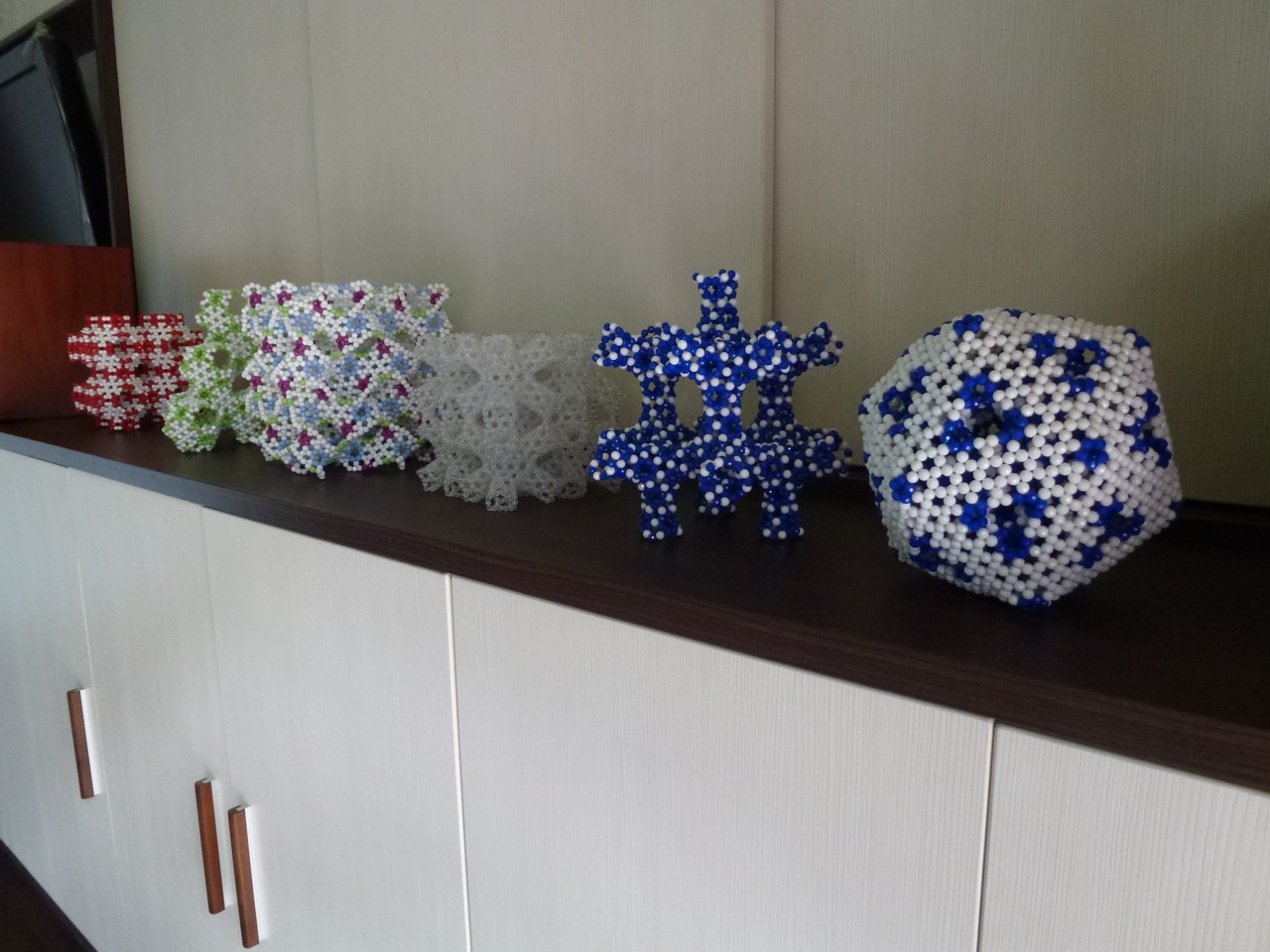
作者們通過在規則的六邊形蜂窩結構中巧妙地插入 八邊形,並在所有三個維度上引入週期性邊界條件,從而獲得了這些 TPMS 的富勒烯對應物。在這些珠飾模型中,八邊形由彩色珠子表示,而六邊形則為白色

特別地,舍恩的 G 曲面 被認為是最難以捉摸的嵌入式 TPMS 之一,然而它卻廣泛存在於生物和材料科學中。如同 P 曲面和 D 曲面可以分別分解為相互連接的懸鏈線和螺旋面單元一樣,G 曲面可以被視為是連接的螺旋面,它們處於懸鏈線-螺旋面等距變形的中間狀態 。這個珠飾的螺線包含 16 個這樣的單元,每個單元的長度為兩個平移單元。模型中,作者使用了三種不同的顏色來表示八元環,因為這些環可以根據其面法線進行分類。在通常的右手笛卡爾坐標系中,面法線沿 x 軸的八元環用紫色珠子表示,而沿 y 軸和 z 軸的則分別用藍色和綠色表示。

背景介紹

富勒烯是由碳原子組成的閉合籠狀或管狀分子。最著名的富勒烯是 C60,又稱巴克球,具有足球狀的結構。富勒烯因其獨特的幾何和電子性質而在化學、材料科學和納米技術等領域引起了廣泛的關注。

三週期極小曲面 (TPMS) 是在三個方向上都具有週期性的極小曲面。極小曲面是指其平均曲率處處為零的曲面,在局部上具有類似鞍形的形狀。TPMS 在數學、材料科學(如液晶和嵌段共聚物的微觀結構)以及生物學中都有廣泛的應用。

舍恩 G 曲面 是一種複雜且重要的 TPMS,因其在自然界和材料科學中的普遍存在而備受關注。其獨特的幾何特性使其成為研究界面現象和週期性結構的理想模型。

網站連結

您可以在 Bridges Organization 的網站上找到更多關於 Chern Chuang、Bih-Yaw Jin 和 Wei-Chi Wei 的藝術作品:

Sunday, March 23, 2025

Beaded (1,1) Gyroidal Surface

Beaded (1,1) Gyroidal Surface - Bridges 2023 數學藝術展

本作品由國立臺灣大學的 陳儀斌(Yi-Bin Chen)(農業經濟學系本科生)製作, 助教何厚勳在設計上做了重要貢獻, 並入選 Bridges 2023 數學藝術展覽

作品簡介

「Beaded (1,1) Gyroidal Surface」是一件基於 螺旋面(Gyroid Surface) 幾何結構的藝術作品,透過數學串珠方法來呈現流線型的曲面結構,展現拓撲學與藝術設計的結合。

創作背景

在國立臺灣大學 金必耀教授 開設的「分子美學」課程中,學生們學習如何將分子結構轉化為可視化的藝術模型。金教授曾展示一個以珠子構建的 (2,0) 螺旋面 模型,啟發了學生們的創作靈感。

Yi-Bin Chen基於這個概念,選擇 (1,1) Goldberg 向量 作為設計基礎,並透過不同顏色的珠子來構建螺旋曲面結構。他特別使用 藍色、紅色與黃色 的八角形珠子,將它們排列在六角形條帶的適當位置,調整模型的曲率,使其呈現自然的螺旋形狀。

作品特色

  • 名稱: Beaded (1,1) Gyroidal Surface
  • 尺寸: 30.0 × 30.0 × 30.0 公分
  • 材質: 6 毫米塑膠珠子、魚線
  • 創作年份: 2022 年
  • 數學概念: 螺旋面結構、Goldberg 向量、拓撲學

藝術家簡介

何厚勳 是國立臺灣大學化學系博士生,專注於碳分子的數學結構與藝術表現。他的研究涵蓋 碳納米管(CNTs)富勒烯(Fullerenes) 及其幾何排列方式。

陳儀斌 是國立臺灣大學農業經濟學系的本科生,對於結合傳統工藝與數學藝術有濃厚的興趣。他透過數學串珠的方法,探索分子幾何的視覺化表達。

數學藝術與拓撲學

螺旋面(Gyroid Surface)是一種在 材料科學、結晶學與數學 中具有重要應用的幾何結構。其特點是沒有鏡面對稱性,卻能形成連續但不相交的三維曲面,這種結構在自組裝材料與光子晶體的研究中扮演重要角色。

「Beaded (1,1) Gyroidal Surface」通過簡單的串珠技術,成功模擬了這種複雜的數學結構,展現數學與藝術的完美融合。

相關連結

「Beaded (1,1) Gyroidal Surface」透過珠子與魚線的簡單元素,展現出拓撲學的精妙之處。這不僅是一件數學與藝術結合的作品,也為分子結構的視覺化提供了新的表現方式,讓觀者感受到數學世界的美麗與秩序。

Friday, August 21, 2015

Two articles about the construction of gyroid- and diamond-type triply periodic minimal surfaces

I wrote two articles in Chinese for the Journal, Chemistry Education in Taiwan (臺灣化學教育) last year. The pdf files have just come out:
1. 左家靜, 莊宸, 金必耀, 大家一起做多孔螺旋與鑽石型三度週期最小曲面的串珠模型(上)─立體幾何介紹,2014 臺灣化學教育, 328-335.
2. 莊宸, 左家靜, 金必耀, 大家一起做多孔螺旋與鑽石型三度週期最小曲面的串珠模型(下)─實作,2014 臺灣化學教育, 336-344.
The title can be translated as "Application of mathematical beading to carbon nanomaterials - A hands-on, collaborative approach to gyroid- and diamond-type triply periodic minimal surfaces with beads, I and II", literally. I described a simple modular approach which was developed mainly by Chern Chuang for making gyroid- and diamond-type Triply Periodic Minimal Surfaces.

Tuesday, December 11, 2012

D- and G-types TPMSs

28 groups of students from TFGH joined the competition designed by Ms. Chou and other teachers in the chemistry group of TFGH. They were asked to make any of these two complicated 3D models based on the slides I prepared for the G- and D-surfaces. It is still nontrivial for a beginner, who has no knowledge on the periodic minimal surfaces and graphitic structures. But most of them succeeded in creaking one of these two models. Unfortunately, when they asked local sellers about the suitable thickness of Nylon strings for 12mm beads. They were told that 0.6mm NyLong strings are best. That is why most of models they made are so soft and unable to stand on themselves. To solve the problem, students came up with the idea to hang these models on four legs of an upside-down desk they use for lectures.

However, one group discovered the cause to be the thickness of the Nylon string. Then students of that group changed the Nylon strings to 0.8mm. The two TPMS models they made are shown in the following photo. They look really nice and beautiful.
The one on the left is the G-surface. The one on the right side is the D-surface consisting of 16 helical strips. Using the decomposition technique Chern Chuang designed, we can use the same helical strips to create these two types of TPMSs.

Gyroidal Invinciball

A graphitic gyroid is a hyperbolic object. To make it, we need to introduce octagons at suitable positions on a graphitic sheet, which is similar to the pentagons in the spherical space such as buckyball. In some sense, we can view graphitic gyroid as a kind of "ball" in the hyperbolic space.

Students from the TFGH created this gyroidal invinciball in the hyperbolic space. Unfortunately, they used 0.6mm Nylon strings for the 12mm faceted beads. The structure is too soft to stand on its own.

Monday, December 10, 2012

Gyroidal National Flag of Republic of China (Taiwan)

I went to a special ceremony for the beading competition held in the Tapei First Girls High School this afternoon. I saw this amazing 3D flag model of my country, Republic of China (i.e. Taiwan), which is made by a suitable color code of octagons in a gyroidal graphene.
BTW, you can also interpret this flag as that of US.

Wednesday, November 21, 2012

G- and D-surfaces in TFGH

Fang-Fei Chou and other teachers of chemistry section of the Taipei First Girl High school (TFGH) started a new bead project based on the slides I made for the anniversary of their school early next month. Using these slides only, they are going to make 2x2x2 G and D surfaces by themselves. Fang-Fei told me that there are about 30 teams in this project, which means they are going to have about 30 giant bead models of TPMS.

Attached is a photo that shows their current progress.
As you can see that their strips are quite long because they use 12mm beads. I made two G surfaces with 6mm and 8 mm beads, respectively. The one made of 6mm beads is about 20x20x20cm. So the G surfaces they are going to make are about 40x40x40cm. I wonder where they are going to put so many gigantic bead models.

Thursday, November 1, 2012

The procedure for constructing G- and D- surfaces

Here are a few slides that show the detailed instruction for making G- and D- surfaces, which I prepared for students and teachers of TFG (Taipei) school. As I said it could be a difficult task because the gyroidal structure and D-type TPMS are complicated structures. The first bead model of a 2x2x2 G-surface took Chern and I almost five years to finally make it. Of course, I have many unfinished bead models of this structure or similar structures with different Goldberg vectors, some made by Chern and some by me, which have mistakes here or there.

In order to how to make this model successfully, we'd better to know the three-dimensional structures of G- and D-type surfaces a little bit. Additionally, it is crucial to know how two structures can be decomposed into several basic unit strips and how to connect these helical strips.

I am also working on an article in Chinese entitled "大家一起動手做多孔螺旋與鑽石型三度週期最小曲面的串珠模型 (A Hands-on, Collaborative Approach to Gyroid- and Diamond-type Triply Periodic Minimal Surfaces with Beads)", which describes in details the procedure to make G- and D-surfaces and also give some background information on TPMS. I might be able to finish the paper in a few days. Hopefully, I will find time to do it in English someday. But, even without detailed explanations, these slides together with other posts in this blog should already contain enough information for people who want to do it.

The first nine slides should give students a better picture of a gyroid:
In slide 10, we can see how a coronene unit corresponds to 1/8 unit cell. Important structural features of a beaded gyroid is summarized in slide 11. Then in slides 12-15, I describe how to make the basic construction unit, a long strip, which should be easy for student to make.
The remaining five slides, 16-20, use schematic diagrams to show how two slides can be combined to generate either D-surface or G-surface.
To create a 2x2x2 gyroidal surface, we need 16 strips, which can be easily done if many people work in parallel. To connect them is nontrivial, you need to follow slides 16-20 carefully. In total, there are about 5000 beads in the model.

Gyroid: simulation vs bead model

I carefully recalculated the region of Gyroidal surface and got a better comparison between the calculated surface and the bead model. The agreement is quite well. We can see the helical strips we used have made the whole structure a little bit longer than 2 unit cells along the z direction.

Friday, October 19, 2012

P, G, and D surfaces

I am planning to have a project with students and teachers of TFG (Taipei) school later this month to construct Gyroidal and D surfaces together. It could be a difficult task because the gyroidal structure is probably the most complicated bead structure Chern and I have ever made. A simple tutorial on the three-dimensional structure of a gyroidal surface and how it can be decomposed into several basic and easily weaved units seems to be useful. So I am now preparing some slides to make the project work out smoothly. Here is one of the slides about the famous P-, D- and G-types Triply Periodic Minimal Surfaces (TPMS) which I generated with matlab:
Additionally, Chern, Wei-Chi, Chia-Chin and I also have a paper jointly for the Bridges meeting last summer. Chern made the presentation. I didn't attend it, though. This paper describes the bead models of these three structures quite generally.

Chuang, C.; Jin, B.-Y.; Wei, W.-C.; Tsoo, C.-C. "Beaded Representation of Canonical P, D, and G Triply Periodic Minimal Surfaces", Proceedings of Bridges: Mathematical Connections in Art, Music, and Science, 2012, 503-506.

Monday, July 30, 2012

Chern Chuang and Paul Hildebrandt with G and D surfaces

A photo of Chern (with G surface) and Paul (with D surface) in the Bridges conference held in the Towson university, Baltimore, USA:
(Photo by Helen Yu)

Monday, March 19, 2012

Photos of Workshop for Exchange Students from Okayama Univeristy

Mr. Hwang took many photos for my workshop last Tuesday.

As usual, I gave a 30-min short talk before we started to make beaded C20 and C60.


While I was talking, students were free to examine the beadworks I brought to the workshop.


Prof. Sonoda (Kyushu University) also visited Taiwan in those few days. So I invited him to this workshop. He seemed to have fun making a beaded C20.


Almost all of students succeeded in making their own C20 and C60 in this 3-hour workshop. You can see how happy they were when they finally made their own buckyballs.
After the workshop, I took a picture with my colleagues.

Thursday, February 16, 2012

Workshop next month and one more gyroidal graphitic structure

I sent the first bead model of gyroidal graphitic structure (GGS) for the math art exhibition of Joint Mathematical Meeting last month. The model is still in Chern's place in Cambridge, MA.

But, I am going to have a three-hour workshop, Molecular Modeling of Fullerenes with Mathematical Beading: a Hands-on Approach, next month in my department for 40 students from Okayama University (Japan) and National Taiwan Universities.

I plan to show students how to construct molecular models of fullerenes with beads and how to correctly interpret microscopic meaning of these bead models. Particularly, students will learn simple beading techniques and create a dodecahedron and a truncated icosahedron, which are C20 and C60 respectively, in this workshop. Additionally, I also wish to have an exhibition of bead models we made in the last few years. Since the bead model of GGS is not with me now, so I decided to make one more bead model of gyroidal graphitic structure.

The bead model is now almost half-done. I wish I can finish the whole model at the end of this month. The model shown in the following photos contains six helical strips. It is quite subtle to make this structure even though I have made one GGS already. At the beginning, I thought I was familiar with the structural rules of the GGS, but I still incorrectly made a D-type TPMS, instead of G-type TPMS, the first time.

Wednesday, January 4, 2012

Exhibition at the JMM meeting

There will be an exhibition about mathematics and art in the Joint Mathematics Meetings held at the Hall D (second level) of Hynes Convention Center, Boston from 1/4 to 1/7, 2012. Chern, Wei-Chi and I have three artworks for this exhibition. If any of you lives or happens to be in the New England close to the Boston area these few days, you are more than welcome to come and share your comments with us!! However, I will stay here in Taipei. Chern is now a graduate student at MIT and will show up in the exhibition room.

Photo took by Chern:

Tuesday, November 8, 2011

Three beadworks for the Joint Mathematical Meeting

Chern and I submitted three beadworks, P-, D- and G-TPMSs, for
the mathart exhibition of Joint mathematical Meeting which is going to be held in Boston next January.

Here I took the two photos from the JMM site:
the first one is the G-TPMS view from another angle:

Beaded Fullerene of Schoen's G Surface
18.5cm x 18.5 cm x 20cm
Faceted plastic beads and fish thread
2011

and also the D-TPMS

Beaded Fullerene of Schwarz's D Surface
23cm x 21cm x 18 cm
Faceted plastic beads and fish thread
2008 (constructed by my former student Wei-Chi Wei)

Monday, November 7, 2011

Two more posters for my exhibition

I made two more A3-size posters with the bead model of gyroidal graphitic surface for the exhibition, "The Fabulous World of Beaded Molecules 串珠幾何的異想世界", on Wednesday.


1. Top view:


2. Side view:

Wednesday, November 2, 2011

Exhibition : The Fabulous World of Beaded Molecules 串珠幾何的異想世界

In conjunction with the special Marie Curie’s exhibition for the international year of chemistry, I am going to have a joint exhibition, "The fabulous world of beaded molecules (串珠幾何的異想世界)", for my beadworks here in the chemistry department of National Taiwan University from 10/9-10/20.


I made a few posters for this event.

P-surface:


D-surface:


G-surface:

Tuesday, September 27, 2011

Monday, September 26, 2011

P, D, and G triply periodic minimal surfaces

Finally, I have all three bead models for P, D, and G minimal surfaces corresponding to the simple cubic, diamond-like, and gyroid-like structures, respectively.