
Showing posts with label beaded polyhedra. Show all posts
Showing posts with label beaded polyhedra. Show all posts
Thursday, June 24, 2010


Yet another bead model of rhombicuboctahedron
Another rhombicuboctahedron using beads with long-aspect ratio:


Tuesday, June 15, 2010

Tuesday, April 6, 2010


Sunday, March 28, 2010
One more beaded rhombic triacontahedron
It is very easy to make rhombic triacontahedron. I made one more using different kind of beads.


Monday, November 16, 2009
Beaded icosahedrons
Beaded models for icosahedron are harder to make. This is because each vertex has five edges connected to it, so one has to face a pentavalent coordination. It is very difficult, if not impossible, to make a pentavalent coordinate with spherical beads. But if want use beads with long aspect ratio, stable and beautiful icosahedral structures can still be made.


Wednesday, November 4, 2009

Monday, May 4, 2009
青城山上的 cuboctahedron


Tuesday, July 15, 2008
Platonic solids with cylindrical bonds
Cylindrical beads that have capsule shape are perfect pedagogical materials for creating physical models of fullerenes since they can look like the chemists' intuition of chemical bonds and, at the same time, effectively mimic the steric repulsion among different beads. To demonstrate these points, here, we use these beads to create the five Platonic solids.

Monday, April 28, 2008
Platonic Solids
I bought these elongated beads last week, on sale, of course. The shape of these beads are closer to that of chemical bonds. I have used these beads to create five Platonic solids. They look great.
Tetrahedron

Cube

Octahedron

Dodecahedron

Icosahedron

Tetrahedron

Cube

Octahedron

Dodecahedron

Icosahedron

Tuesday, December 4, 2007


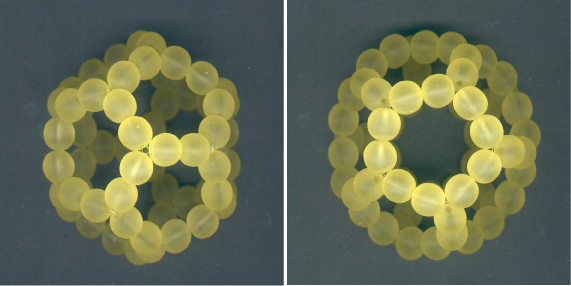


C60 with each bond built from two spherical beads and one tube
In the following figure we show the beaded model for C60 based on the composite bead technique. The final shape is not quite satisfying as we can see it is a little bit distorted. This is probably due to that the sizes and shapes of the constituent beads and tubes are not exactly the same. I believe a better structure can be constructed if we can control the sizes and shapes in a better way.


Monday, December 3, 2007
Dodecahedral C20 with correct bond shape and force field
Previously, I have shown that beads with spherical shape can effectively mimic sp2 force field of fullerenes. However, these beads represent bonds instead of atoms. This may lead to confusion for students. We can avoid this problem by using beads with large aspect ratio, but the resulting structure usually has poor mechanical stability. Here Chuang has created a nice beaded fullerene of C20 (Ih) which can clearly exhibit the bond network of fullerene and at the same time possess great stability.


Subscribe to:
Posts (Atom)