.001.jpg)
Showing posts with label chiral. Show all posts
Showing posts with label chiral. Show all posts
Thursday, March 26, 2015
Torus knot (2,9) by Kazunori Horibe
Kazunori email these photos of a beautiful bead model of (2,9)-Carbon nanotube torus knot (CNTTK) he just made the other day. To make the structure more clearly, I also use the Grapher to create the corresponding torus knot.
.001.jpg)


Tuesday, April 3, 2007
Higher Fullerenes with I or Ih symmetry
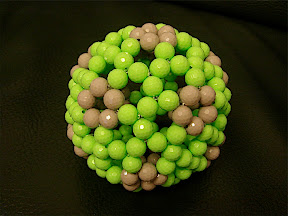
Construction of higher fullerenes belonging either to I or Ih point groups is an interesting experience to me. There are not many of them, compared with all possible isomers. It seems to me it is not necessary to use the spiral algorithm I describe before. The symmetry of the systems pose a strong limitation on the possible positions of pentagons. By inspection, we can find out the systematic strategy for generating all possible higher fullerenes. I will explain my strategy later. Here are all possible I or Ih fullerene with the number of carbon atoms less 300.
C60(Ih), C80(Ih), C140(I), C180(Ih), C240(Ih), C260(I)
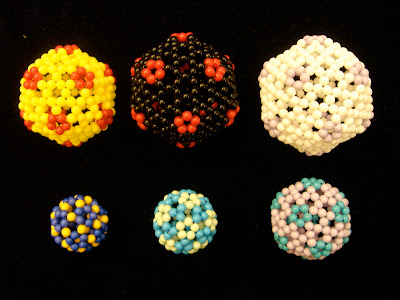
Chiral Compounds:

Honestly speaking, the colors I chose for these compounds are terrible. I am thinking about remaking these models. Maybe some of you can help.
C60(Ih), C80(Ih), C140(I), C180(Ih), C240(Ih), C260(I)
Chiral Compounds:

Honestly speaking, the colors I chose for these compounds are terrible. I am thinking about remaking these models. Maybe some of you can help.
Tuesday, December 12, 2006
Ten isomers of T240
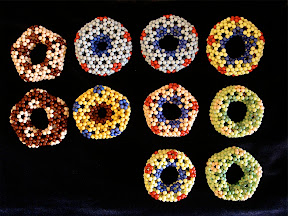
Here are ten isomers of T240 I currently made. I guess there are at least two more high-symmetry T240 in this family.
You can see the two empty positions in the picture are for these two isomers.
It is worthy to note that there are three chiral structures in these 10 tori. If included, there are 15 isomers in total for T240.
You can see the two empty positions in the picture are for these two isomers.
It is worthy to note that there are three chiral structures in these 10 tori. If included, there are 15 isomers in total for T240.
 |
| From Craft Projects |
Monday, December 4, 2006
Chiral T240 belonging to C5 point group
I have managed to make the chiral isomer of T240 (D5h) by shifting the pentagons on the outer rim by one bead. Unfortunately, I was unable to put the beads into a complete torus due to the huge strain energy for this structure. The stable chiral forms of T240 originating from the isomer with D5h point group do not exist! It is quite amazing it is possible to get a first order approximation for the geometry and stability of carbon spheroids or toroids by using molecular beadings. But the price to pay is that you need to spend several hours on the beadings for a single structure.
Previously, I have made two D5h T240 which can be converted into each other by Stone-Wales transformation. But, according to Ihara's paper, there seems to be another kind of T240 isomer which can be generated by moving ten pentagons on the outer rim to the mid-edge position (i.e. shifting 36 degree about z-axis). I am not sure about the stability of this structure. But since the outer-rim pentagons and inter-rim heptagons are arranged in the staggered pattern, I suspect the strain energy for this type of structure is large.
Previously, I have made two D5h T240 which can be converted into each other by Stone-Wales transformation. But, according to Ihara's paper, there seems to be another kind of T240 isomer which can be generated by moving ten pentagons on the outer rim to the mid-edge position (i.e. shifting 36 degree about z-axis). I am not sure about the stability of this structure. But since the outer-rim pentagons and inter-rim heptagons are arranged in the staggered pattern, I suspect the strain energy for this type of structure is large.
Carbon Toroids with D5h Symmetry
Up to now, all of the toroids I made and posted here belong to either D5d or C5 point groups. Molecules with D5d symmetry have mirror symmetry. So they are achiral compounds. But those molecules with C5d symmetry are chiral.
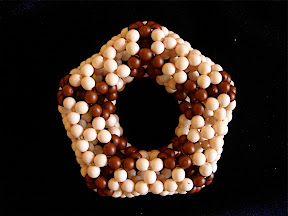
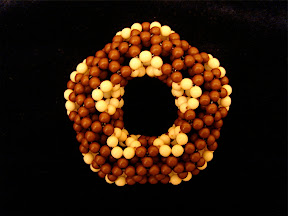
In addition to these types of compounds, there exists the third kind of toroids with D5h symmetry. Since they have inversion symmetry, molecules belongs to this catogory are optically inactive. I have made two beaded toroids of this kind this weekend. Both contain 240 carbon atoms.
Interestingly, these two are connected to each other by the Stone-Wales transformation.
D5h T240 a

D5h T240 b
Geometry generated by Chuang.

In addition to these types of compounds, there exists the third kind of toroids with D5h symmetry. Since they have inversion symmetry, molecules belongs to this catogory are optically inactive. I have made two beaded toroids of this kind this weekend. Both contain 240 carbon atoms.
Interestingly, these two are connected to each other by the Stone-Wales transformation.
D5h T240 a
 |
| From Craft Projects |

D5h T240 b
 |
| From Craft Projects |
Geometry generated by Chuang.

Friday, December 1, 2006
Thursday, November 30, 2006
Another three isomers of Torus 200
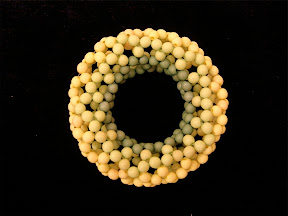
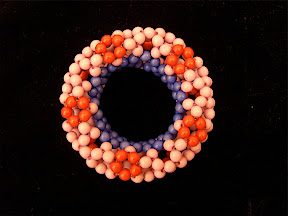
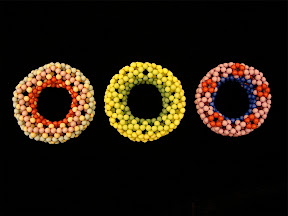
Torus 200 has another three isomers, two are chiral and the other is achiral as shown below. Since two chiral molecules are mirror image of each other, so I only stitch one of them.
Chiral Torus 200
Achiral Torus 200
All three in a row
Chiral Torus 200
 |
| From The Beaded Mo... |
Achiral Torus 200
 |
| From The Beaded Mo... |
All three in a row
 |
| From The Beaded Mo... |
Monday, November 27, 2006
Chiral Toroid 240: T240
The previous two C240 isomers both have an inversion center. Hence, both of them are achiral, which means the mirror of the molecule is identical to itself. However, it is not difficult to find out it is possible to generate a chiral toroid by slight shifting of pentagons on the outer rim by one unit cell. Here is the result of the chiral isomer of the previous two structures.


The Simplest Beaded Toroids
In addition to spherical object such as C60, it is also possible to construct structures with spheroidal and toroidal shape by beading. The most difficult part of the construction is that we have to figure out the correct connectivity between different beads. I will discuss this issue later.
Here are the simplest beaded toroids with 120 carbon atoms I made.
The first molecule has D5d symmetry.
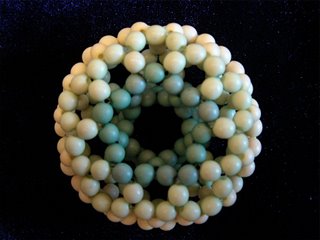
Another C120 isomer is a chiral molecule.
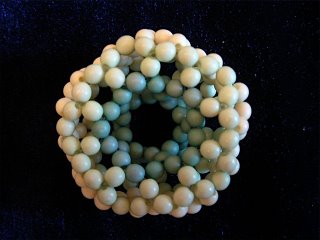
Here are the simplest beaded toroids with 120 carbon atoms I made.
The first molecule has D5d symmetry.

Another C120 isomer is a chiral molecule.

Subscribe to:
Posts (Atom)