Showing posts with label fractal. Show all posts

Saturday, March 15, 2025

Beaded Menger Sponge 門格海綿串珠模型

門格海綿串珠模型

這件作品由國立臺灣大學的學生Yan-Yang Ji、 Zi-Yi Dai、 Po-Cheng Wu, 在金必耀教授的《分子美學》課程中製作,並展示於 2021 年聯合數學會議(Joint Mathematics Meetings)Bridges 數學藝術畫廊。 作品展示頁面: Bridges Math Art Gallery

門格海綿與分形幾何

門格海綿(Menger Sponge) 是 1926 年奧地利數學家 Karl Menger 提出的分形結構,是最經典的三維分形之一,其建構方式類似於謝爾賓斯基地毯(Sierpiński Carpet)的三維版本。 門格海綿的幾何特性包括:

  • 透過遞迴方式產生,每一步將立方體分割為 27 個小立方體,並移除中央及每個面的正中央小立方體。
  • 具有無限小尺度的自相似性,即每個子結構與整體形狀相似。
  • 其體積趨近於 0,但表面積趨於無窮大,反映出典型的分形性質
  • 拓撲學上,它是零維拓撲空間(Zero-dimensional Topological Space)的一個範例。
  • 豪斯多夫維度(Hausdorff Dimension) 為 log(20) / log(3) ≈ 2.7268。

門格海綿不僅是一個數學上的趣味結構,也在許多科學領域(如材料科學、結構工程、奈米技術)中有應用價值。例如:

  • 材料科學中,可作為多孔材料(如泡沫結構)的數學模型。
  • 電磁波研究中,被用來設計具有特定頻率選擇性的天線結構。
  • 流體力學中,可用來模擬多孔介質的流體滲透特性。

門格海綿串珠模型

  • 尺寸: 10 x 10 x 10 公分
  • 材料: 6 毫米塑膠珠
  • 製作年份: 2020 年

作品介紹

這個模型使用串珠技術來建構門格海綿的遞迴結構,展示其分形幾何特性。學生們使用塑膠珠來模擬立方體的節點,並透過彈性線串聯,使其形成穩定的三維結構。

由於實際上無法構造「無限階」的門格海綿,本作品以第三階(Level-3) 門格海綿為基礎:

  • 起始時是一個完整的立方體(Level-0)。
  • 第一步將其分割為 27 個小立方體,並移除中央及每個面的中心立方體(Level-1)。
  • 第二步對剩餘的 20 個小立方體重複相同過程(Level-2)。
  • 第三步再對 Level-2 的結構進行相同操作,形成更細緻的分形結構(Level-3)。

這個模型最終展示出門格海綿的自相似性與遞迴幾何,並且透過串珠技術,讓觀眾能夠直觀感受這種數學結構。

數學與科學應用

這個模型的研究對數學、物理與工程科學有多方面影響:

  • 在數學領域,提供了一種可觸摸的方式來理解分形結構豪斯多夫維度的概念。
  • 在物理學中,可用來模擬多孔結構材料,並探索其熱傳導、聲學與流體動力學行為。
  • 在材料科學中,類似結構可應用於輕量且高強度的奈米結構,例如氣凝膠與泡沫金屬。

透過這件作品,學生們不僅學習了分形幾何的概念,也體驗了數學藝術如何能夠將抽象概念轉化為具象化模型。

Thursday, October 23, 2014

Evolution of superbuckyballs

Since the last month of 2011, I started to work on the so-called Sierpinski buckyballs or superbuckyballs, which belong to a particular family of fullerenes created by treating C60s as supernodes and carbon nanotubes as superbonds. Using this idea, an unlimited number of hierarchical super-structures of sp2-hybridized (3-coordinated) carbons can be constructed. Before this task was really started, I have managed to build some simpler structures such as super-triangle, super-tetrahedron, and other related structures. With the experience, I firmly believed in the feasibility of creating bead models of much larger superbuckyballs. But it is too tedious to construct bead models for this kind of super-structures, especially the so-called C60xC60, alone. So I designed a modular approach to build these models collaboratively. I told a few chemistry teachers, especially Dr. Chou (周芳妃), at a local high school, The Taipei First-Girl School (TFGH), about this structure. They were glad to try this idea out together. The results are two beautiful superbuckyballs (or C60xC60) made by 6mm and 12 mm beads, respectively. Both of the structures were on public display for the anniversary of TFGH and a simultaneous event of the TFGH's 30-year alumni reunion. Alumni association of TFGH kindly supported the whole project. Dr. Tsoo was one of alumni that year, that was why we got supported from them.
Later on, I made another bead model of C60xC60 for the JMM held in San Diego about two years ago (Jan. 2013). I used the photo of the giant bead model students and I made in the JMM description though. I met Chern (莊宸) in the meeting. We discussed the structural rules for this family of compounds. Particularly, I commented on that the particular model I made cannot be constructed by Zometool. After returning back to Cambridge, MA, Chern solved the problem by carefully puncturing holes along certain symmetry axes in order to be consistent with the Zometool requirements.
Yuan-Jian Fan (范原嘉) then proved Chern's idea by building a virtual C60xC60 super-buckyball with the zometool construction software, vZome, which was kindly given to us by its author, Scott Vorthmann, a few years ago. With everything ready, a few enthusiastic students from the theoretical chemistry group of the National Taiwan University started to build the first zometool super buckyball after the Chinese new year.

Soon, a number of practical issues on the construction of a real zometool model of C60xC60 super-buckyball appeared. The first issue is the structural stability against gravity. The original neck structures (shortest situations) designed by Chern consisted of a number of octagons were too weak and simply cannot hold the whole structure due to its own weight. Another issue is still weight, without extra stands, the southern hemisphere of super-buckyball constructed by zometool simply cannot hold the northern hemisphere. Finally, how to put those parts on top without scaffold is also a question. All these problems were solved beautifully by Yuan-Jia Fan. Of course, local dealer, Helen Yu, of Zometool in Taiwan is also helpful. She always responded us with the necessary zometool pieces upon our requests in a very short time. So, we can have the first zometool sculpture of C60xC60 erected in the NTU campus around mid-March.
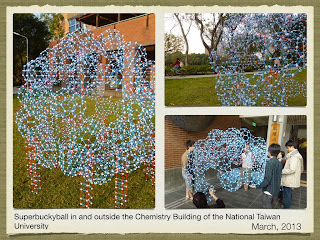
Chern then proposed to Paul Hildebrand to have a family-day activity for the 2013 Bridges which will be held in Enschede that year. Paul agreed to provide us with the necessary materials. At the family day, we got more help from a few Bridges participants and their family members from Taiwan. These included Profs. Liu (劉柏宏) and Tung-Shyan Chen (陳東賢). Without them the final C60xC60 structure couldn't be finished in such a short period.
In addition to the construction of huge zometool superbuckyball, Chern also presented a small bead model to the Bridges meeting as shown in the following pictures based on the same construction rule he designed. Another bead model in his right hand is an edge-elevated dodecahedron assembled from fifty C80s, twenty for the vertices of dodecahedron and thirty for the elevated edges. The idea for making this one is similar to C60xC60. I brought them back to Taiwan and put them on exhibition in the NTU Chemistry Museum for about a year until the last July when Chern got an email from George Hart asking him about the possibility of donating this small C60xC60 model for MoSAIC (Mathematics of Science, Art, Industry, and Culture) traveling exhibition. In the email, George commented on this model as " having the right combination of artistic expression, mathematical content, and practical transportability".

Wednesday, March 6, 2013

Third level Sierpinski superbuckyball: C20⊗C20⊗C20

As was asked by Bih-Yaw, I think in principle one can always go on the process of using fullerenes to construct superfullerene, and then treat the result as the new module to build a supersuperfullerene etc.. The idea is the same. The problem is always physical limitations: the structure goes too heavy to support itself or you run out of memory trying to build that on a computer. Here is the simplest nontrivial case that I can do on my laptop, a third level superfullerene C20⊗C20⊗C20.

C20⊗C20⊗C20 with g=(1,1): C15920 (Ih)


It is clearer to see when there are only two adjacent nodes:


I would say this is not unbeadable. However, as mentioned, one has to make sure the structure is strong enough to hold itself up. In my experience the best shot is to go with 3mm plastic beads and 0.4mm fish lines, which I'm currently using for the construction of a C60⊗C60 superfullerene. Other possibilities are icosahedron⊗icosahedron⊗C60 or cube⊗cube⊗C60, but I think they are not as representative and illuminating as this one.

Friday, March 1, 2013

Short summary of zome-type superbuckyball part III: Polyhedra

In this post I will present some other polyhedra built with the same principle. As you might know that the C20 and the C60 discussed in the previous post are exactly regular dodecahedron and the truncated icosahedron (an Archimedean polyhedron).

Cube⊗C60 with g=1: C624


I'd like to note that the symmetry of this structure belongs to the Th point group, although it looks as if it's got a higher symmetry of octahedral group. This is so because of the fact that locally there is only C2 rotational symmetries along each of the joining tubes. And there is no C4 rotational symmetry, not only in this structure but also in all other structures constructed with the golden ratio field where zometool is based on.

Icosahedron⊗C60 with g=2: C1560


I've posted a closely related high-genus structure quite some time ago using a different algorithm. There I treated the construction of high-genus fullerenes by replacing the faces of the underlying polyhedra by some carefully truncated inner part of a toroidal CNT. As suggested by Bih-Yaw that the current scheme of constructing superfullerenes is one another aspect of high-genus fullerene. Previously we are "puncturing holes" along the radial direction and connecting an inner fullerene with an outer one. Here we break and connect fullerenes in the lateral directions. Although topologically they are identical, as you can see the actual shapes of the resulting super-structures are quite different.

For your convenience I repost the structure here for comparison:


The construction of (regular) tetrahedron and octahedron requires the use of green struts. For now I have not come up with the corresponding strategy for green strut yet. We will move on to other polyhedra in the rest of this post.

Small Rhombicosidodecahedron⊗C60 with g=1: C5040


This Archimedean solid is of special interest since the ball of zometool is exactly it. The squares, the equilateral triangles, and the regular pentagons correspond directly to C2, C3, and C5 rotational axes, respectively. The existence of this superfullerene guarantees the possibility of building hierarchy of Sierpinski superbuckyballs. In other words, this superbuckyball can serve as nodes of a "supersuperbuckyball", with the connecting strut automatically defined. Although we are likely to stop at the current (second) level because of physical limitations, either using beads, zometool, or even just computer simulations.

Rhombic triacontahedron⊗C60 with g=1: C3120


You need red struts only for this structure.

Five compound cubes⊗C60 with g=(0,1): C6000


You need blue struts with two different lengths for this structure, which is the reason why the g factor is a two component vector here. Note that at each level the length of the strut (measured from the center of the ball at one end to the center of the other) is inflated by a factor of golden ratio. Thus, comparing to other superfullerenes introduced previously, there is additional strain energy related to the commensurability of the lengths of CNTs. It is always an approximation to use a CNT of certain length to replace the struts of a zometool model. It is also interesting to note that, comparing to the zometool model, this particular superbuckyball makes clear reference to the encompassing dodecahedron. In this perspective it is not surprising that the structure has Ih symmetry.

Dual of C80⊗C60 with g=2: C5880


This structure is obtained by inflating each of the equilateral triangles of a regular icosahedron to four equilateral triangles. An equivalent way of saying this is "inflation with Goldberg vector (2,0)".

In addition to the above mentioned, Dr. George Hart has summarized some of the polyhedra construtable with zometool here. In principle they can all be realized, at least on computers or with beads and threads, by this methodology. And there is going to be one last post in this series to cover those that are not classifiable into categories discussed so far.

Thursday, June 10, 2010

The Bead Model of Sierpinski Tetrahedron

Previously, I have shown the Sierpinski buckyball made by Chuang (莊宸) and his classmates (Class 2007, Chemistry, NTU) about three years ago. It is also straightforward to make other Sierpinski Platonic solids. Here is the simplest one: the beaded Sierpinski tetrahedron.

Saturday, March 6, 2010

Friday, June 1, 2007

Escher's buckyball

Chern Chuang and his classmates created this amazing beaded buckyball made from 90 small beaded buckyballs. They are going to present this beautiful artwork as a gift to our chemistry department in the graduation ceremony for NTUCHEM class 2007 this coming weekend. I wish I can have a picture for this event.

As to the name of this design, we call this ball as a buckybuckyball, or level-2 buckyball. Since we can again use this buckyball as a new type of beads to create the next level of buckybuckybuckyball (level-3 buckyball), continuing in this direction recursively, we can have a very complicated fractal structure of Sierpinski type. Also, this kind of artwork containing hidden recursive structures has been first used Escher in his amazing artworks, so it is not a bad idea to call this kind of buckyball as Escher's buckyball, or Escher's ball.