Showing posts with label carbon nanotubes. Show all posts

Wednesday, October 5, 2011

Network of perpendicular carbon nanotubes (2x2x2)

I cut off all loose ends of fishing threads. It looks pretty. This model is the largest one (about 22.5cm x 22.5cm x 22.5cm) among all beadworks I had now. Again, I used two different colors of 6mm beads to make it. Red beads are used to make 7-bead groups (heptagons) and white beads for the other 6-bead groups (hexagons). CNTs in this structure belong to the zigzag form of CNTs.

Monday, October 3, 2011

Network of perpendicular carbon nanotubes (2x2x2)

I spent time to finish up this structure made of 12 interpenetrating carbon nanotubes (CNTs) last weekend. Compared to the G-surface, this structure is not that complicated. Once one figures out the structure of node that connects three different perpendicular CNTs, the rest is hard work. One should be able to see how the arrangement of heptagons in a node is related to the inner part of a toroidal carbon nanotubes (TNCTs).


Tuesday, August 16, 2011

Network of perpendicular carbon nanotubes

I am working on a structure consisting of a network of inter-penetrating carbon nanotubes that are perpendicular to each other. Only four unit cells are done currently. Hopefully I can finish the next four unit cells in next few weeks.


This structure is very similar to the one posted in
"Pseudo P-type carbon Schwartzite", except that I inserted a segment of carbon nanotubes in between each two nearest-neighbored junctions. Three mutually perpendicular carbon nanotubes meet at a junction that contains 24 heptagons. Moreover, one can also easily identify eight monkey saddles at each junction.

Friday, April 6, 2007

Endcapped nanotubes

I just finished writing the section on the influence of endcaps on the nanotube's shape in my "The beaded molecules I. Spheroids" paper. I put my emphasis on (5,5) and (9,0) SWNT with the C60 endcaps, which is fine. I thought there should be a more systematic study on the effect of endcaps from the beaded molecule's viewpoints. This should include the patching conditions, chiral nanotubes and the effect on the shape change. I have no doubt that many of the issues I raised here probably have been treated before. I still think it is worthy to do it with the beaded molecules.


Wednesday, April 4, 2007

The effect of endcaps on the shapes of nanotubes

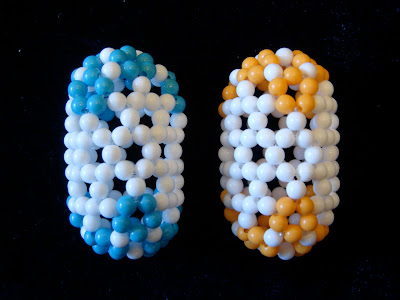
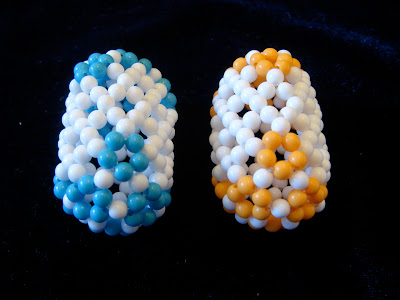
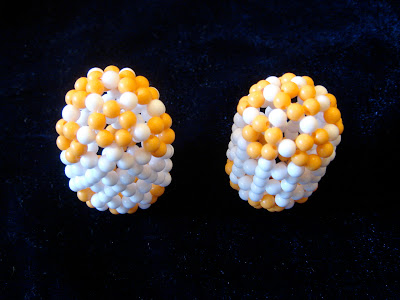
Supprising results do occur every time I try to make a new type of beaded molecules. For instance, I didn't expect to find anything particular interesting about the endcaps of the nanotube. I have built two short nanotubes endcapped with C60 along the five-fold symmetry axis more than two months ago. I have also taken a few pictures for these molecules. Well, the result looks good, the tubes are just like perfect cylinders. This is probably because there is little difference between five-fold symmetry and perfect rotational symmetry around the central axis. The lower symmetry of endcaps does not seems to produce broken symmetry. Or may be the effect is too small to notice at first sight.

I made another tube also with C60 endcaps, but instead of along five-fold symmetry axis, this time I patch the tube with the three-fold symmetry axis. I was amazed by the broken symmtry of the nanotube induced by the three-fold endcaps. Since there are many possible ways to connect the tube with the endcaps, depending on the relative orientation of the two endcaps. I found that the resulting endcapped nanotube can be either achiral or chiral, even though the uncapped nanotube is achiral. I wonder whether other people have noticed these interesting situations or not?