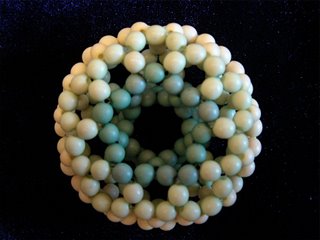
I recently saw a post on the clover-shaped carbon tori by my facebook friend, Tetsuaki Hirata, who is an artist from Himi, Japan
and seems to be a frequent visitor of this blog. After I showed Chern about his works, Chern told me he has thought about
this kind of clover-shaped carbon nanotori quite some times ago. Indeed, Chern has published a number of papers on the tubular graphitic
structures. He is probably one of few people who know a lot about this kind of graphitic structures, especially on how the nonhexagons could influence the structures of a carbon nanotube.
I am not surprised that he thought about this kind of structures.
1. Chuang, C.; Fan, Y.-C.; Jin, B.-Y.*
Generalized Classification of Toroidal and Helical Carbon Nanotubes J. Chem. Info. Model. 2009, 49, 361-368.
2. Chuang, C; Fan, Y.-C.; Jin, B.-Y.*
Dual Space Approach to the Classification of Toroidal Carbon Nanotubes J. Chem. Info. Model. 2009, 49, 1679-1686.
3. Chuang, C; Jin, B.-Y.*
Hypothetical toroidal, cylindrical, helical analogs of C60 J. Mol. Graph. Model. 2009, 28, 220-225.
4. Chuang, C.; Fan, Y.-C.; Jin, B.-Y.*
On the structural rules of helically coiled carbon nanotubes, J. Mol. Struct. 2012 1008, 1-7.
5. Chuang, C.; Fan, Y.-J.; Jin, B.-Y. Comments on structural types of toroidal carbon nanotubes, arXiv:1212.4567,
2013 submitted to J. Chin. Chem. Soc.
In the first two and the 5th papers, we talked about general structural rules of carbon nanotori and only touched helices briefly. In the next two papers,
we discussed very generally how the horizontal and vertical shifts (HS and VS) can be exploited to change the direction of a straight carbon nanotube in order to obtain an arbitrary helically coiled carbon nanotubes. In Chern's Ms thesis,
he also showed how to take advantage of HS and VS to create trefoil knots or torus knots in general, which was
later summarized in a brief review we wrote, "Systematics of Toroidal, Helically-Coiled Carbon Nanotubes, High-Genus Fullerenes, and Other Exotic Graphitic Materials."
(Procedia Engineering, 2011, 14, 2373-2385).
Clover-shaped TCNTs are just a special class of more general curved carbon nanotubes we considered.
A simple strategy is to introduce 180 twists along the tube direction (i.e. 180 degree VS) at suitable positions. I got a few
nice figures of clover-shaped TCNTs from Chern the other days.
Among all these clover-shaped tori,
I particularly like the five-fold carbon star.
Showing posts with label Simulation. Show all posts
Monday, February 4, 2013
Thursday, November 1, 2012
Gyroid: simulation vs bead model
I carefully recalculated the region of Gyroidal surface and got a better comparison between the calculated surface and the bead model. The agreement is quite well. We can see the helical strips we used have made the whole structure a little bit longer than 2 unit cells along the z direction.
Saturday, October 20, 2012
Another way to view D surface
There is another way to partition the D-surface to its constituents. It looks quite different.
It would be interesting to compare these pictures with the bead model of D surface Wei-Chi made:
(http://www.ams.org/mathimagery/displayimage.php?album=32&pid=418#top_display_media, AMS Math Imagery)
Friday, October 19, 2012
P, G, and D surfaces
I am planning to have a project with students and teachers of TFG (Taipei) school later this month to construct Gyroidal and D surfaces together. It could be a difficult task because the gyroidal structure is probably the most complicated bead structure Chern and I have ever made. A simple tutorial on the three-dimensional structure of a gyroidal surface and how it can be decomposed into several basic and easily weaved units seems to be useful. So I am now preparing some slides to make the project work out smoothly. Here is one of the slides about the famous P-, D- and G-types Triply Periodic Minimal Surfaces (TPMS) which I generated with matlab:
Additionally, Chern, Wei-Chi, Chia-Chin and I also have a paper jointly for the Bridges meeting last summer. Chern made the presentation. I didn't attend it, though. This paper describes the bead models of these three structures quite generally.
Chuang, C.; Jin, B.-Y.; Wei, W.-C.; Tsoo, C.-C. "Beaded Representation of Canonical P, D, and G Triply Periodic Minimal Surfaces", Proceedings of Bridges: Mathematical Connections in Art, Music, and Science, 2012, 503-506.
Friday, June 4, 2010
IWP Surface with 2-by-2-by-2 Unit Cells
This is the beaded molecule, or beaded solid, that I brought to Taipei yesterday, one with 3,456 carbon atoms.
Labels:
Extended Structures,
hyperbolic,
I-WP surface,
Periodic Minimial Surfaces,
Schwarzite,
Simulation
Monday, November 9, 2009
Ih-Symmetric C380 : The Smallest Stable 11-Genus Graphenoid (A Repost from byjingroup blog)
This is the smallest possible 11-Genus Ih-symmetric fullerene while its stability is comparable to the usual TCNT C120 we acquainted with. The MOPAC AM1 optimization is still on progress. This kind of molecule is made from puncturing 12 identical holes, which I prefer to term them as (D5d-symmetric) necks, between a pair of concentric dodecahedron and icosidodecahedron, both tiled properly with graphene patches.
However, I think that this molecule is of particular interest because it is really small and in the mean while stable. The geometric features, as in the TCNT case, are controlled by four parameters. But in contrast to the TCNT case, these four parameters put huge constraint on the output molecule's stability. Which is to say, only a few of the parameter combinations under certain number of atoms are of practical interest, as compare to the large variety of TCNT isomers. In particular, I think this could be the only stable high-genus fullerene under 500 atoms.
In the literature, only the Terrones group have had studied this kind of HG fullerene. But I have never noticed that if they ever described the general rule of how the molecules are constructed. Beside knowing exactly how the construction rule works in their cases, the experience we learned from TCNT construction scheme allows me to develop a trick of building HG fullerene with far fewer number of atoms than them, which I shall describe in later posts.
BTW, I think this molecule is the best suited one for making its beaded molecule. I have made two of them, here's one:
Viewed along a C5-axis,
Viewed along a C3-axis,
The size compare to D6d TCNT C144,
(Posted on byjingroup blog by Chern Chuang, Wednesday, November 5, 2008)
Monday, October 26, 2009
2D periodic Archimedean tiling (Repost)
This is one of the eleven possibilities of Archimedean tilings of neck structures, which I've finished coding lately. Each vertex of the tiling is composed of three equilateral triangles and two squares.
The ms that I am currently working on is titled "Doubly and Triply Periodic Porous Graphitic Structures". I wonder if you have better suggestion to the title. I was first considering doubly and triply periodic quasi-minimal surfaces, since I am not sure that mathematicians would agree that these are minimal surfaces realized as graphitic structures. The paper on high-genus fullerenes that we've just published uses the word "high-genus". Although the periodic structures discussed in this new article are still made of neck structures, they may not be as high-genus as their 0D analogs since the genus value per unit cell is not-so-high.
(By Chuang on byjingroup blog, Tuesday, July 21, 2009)
A beaded model for 2-d periodic tile (Platonic tile) of graphitic structures made by Chuang a few months ago:
The ms that I am currently working on is titled "Doubly and Triply Periodic Porous Graphitic Structures". I wonder if you have better suggestion to the title. I was first considering doubly and triply periodic quasi-minimal surfaces, since I am not sure that mathematicians would agree that these are minimal surfaces realized as graphitic structures. The paper on high-genus fullerenes that we've just published uses the word "high-genus". Although the periodic structures discussed in this new article are still made of neck structures, they may not be as high-genus as their 0D analogs since the genus value per unit cell is not-so-high.
(By Chuang on byjingroup blog, Tuesday, July 21, 2009)
A beaded model for 2-d periodic tile (Platonic tile) of graphitic structures made by Chuang a few months ago:
An icosahedral HGF (repost)
I finished extending the original code in the appendix of my thesis last night.
This particular HGF has its triangular necks with g=0, i.e. there is no carbon atoms ``at'' the neck, with three decagons per neck. And it contains 1260 carbon atoms. However since I didn't actually patch decagons on the molecule, here is the original Matlab .fig file, which may provide a better look of the molecule.
(By Chuang on byjingroup blog, Sunday, October 18, 2009)
This particular HGF has its triangular necks with g=0, i.e. there is no carbon atoms ``at'' the neck, with three decagons per neck. And it contains 1260 carbon atoms. However since I didn't actually patch decagons on the molecule, here is the original Matlab .fig file, which may provide a better look of the molecule.
(By Chuang on byjingroup blog, Sunday, October 18, 2009)
Thursday, December 25, 2008
Saturday, July 5, 2008
D168
The 3D structure of D168 we posted a few days ago is incorrect. Chuang has now the correct structure shown below:
I thought it is not a bad idea to have a beaded model for this structure. Now I am still at a very preliminary stage (see the picture shown below).

Eventually, I expect to have a D168 structure similar to Adamantane:
I thought it is not a bad idea to have a beaded model for this structure. Now I am still at a very preliminary stage (see the picture shown below).

Eventually, I expect to have a D168 structure similar to Adamantane:
Monday, June 30, 2008
Thursday, June 26, 2008
Sunday, June 15, 2008
More 3-D tori created by Append Huang: repost from byjingroup blog
Here is a simple example of series of leapfrog transformation. Note that after each operation the number of atoms is tripled.
T120
T360
T1080
T120
T360
T1080
Guess What?
Thanks to the great help from Append Huang!
Wednesday, September 5, 2007
Including the Lower Half of the Simulated Figure
Tuesday, September 4, 2007
A comparsion between the simulated figure and real picture of T120


From these two pictures, we can see the strong resemblance between beaded models and the corresponding computer optimized fullerenes. This again demonstrates the validity of our discovery about the analogy between the macroscopic force field of beaded molecules and the microscopic VSEPR of sp2 bonding.
I wonder whether we should include the lower half of beads in the computer-generated picture or not. The simulated picture looks like that something is missing.
Computer-Generated Figures of Beaded Molecules
The lower halves of them are excludedI have tried to use Matlab to draw our beaded molecules. The results are shown below: (The lower halves of them are omited.)
Subscribe to:
Posts (Atom)