Tuesday, July 8, 2014

2014 NTU Summer Chemcamp (臺大暑期化學營)

These few days, there is a chemistry camp at the Chemistry Department of National Taiwan University (NTU). I was asked to give a workshop on the last day (Jul. 10, 2014) of this activity for these high-school kids coming from around the whole Taiwan and the Penhu islands (or the Pescadores Islands). The camp started yesterday afternoon, I had an opportunity to introduce them briefly about my beadworks in front of two display cases. Here are two photos from the event:


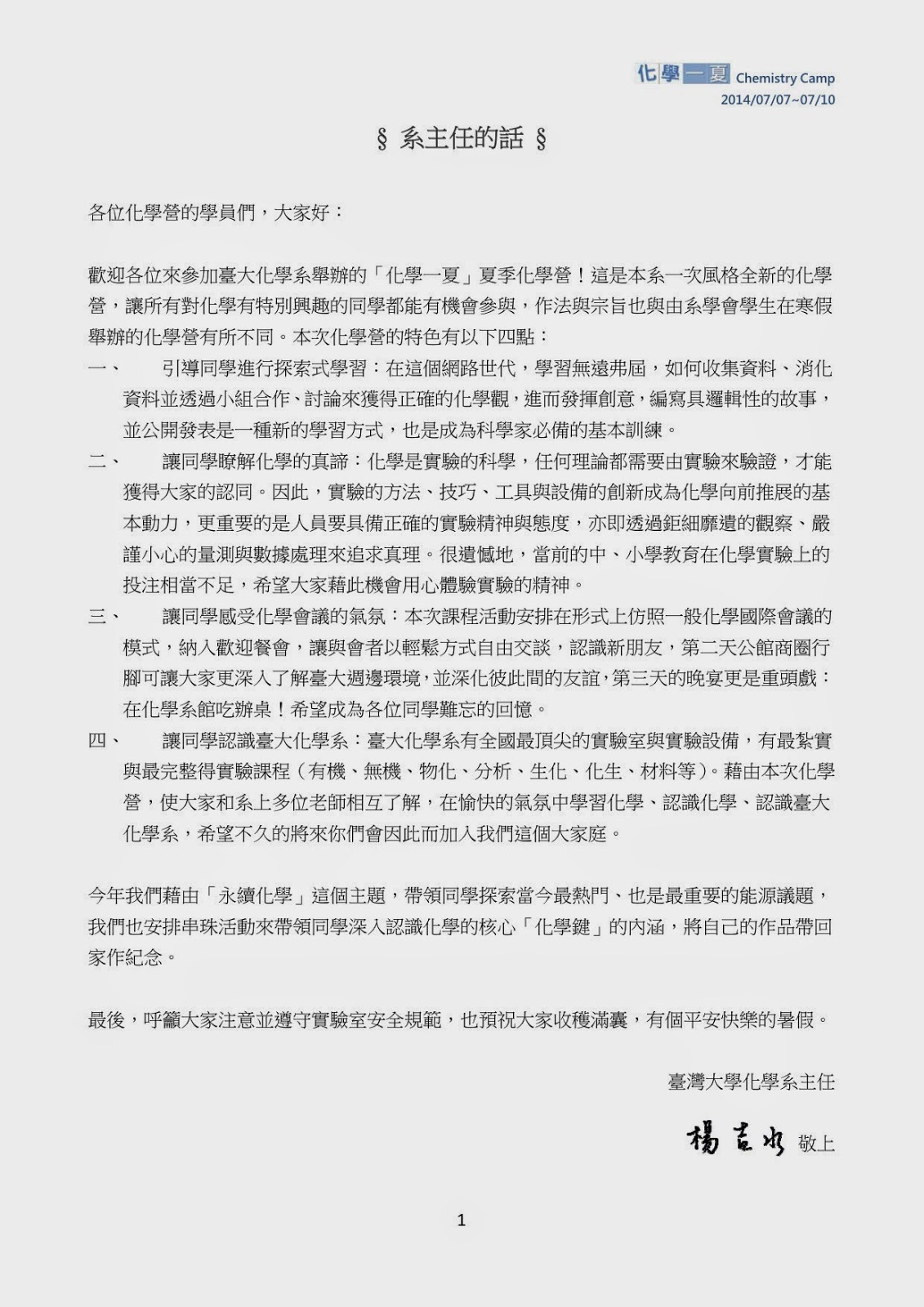
The first few pages of the handout for this chemcamp.

Monday, July 7, 2014

Workshop in Seoul

Mr. Horibe and I will give a workshop for the Bridges conference this coming August. Basically, we will follow the format we had in our joint workshop given in Taiwan this March. Horibe-San will first give a half-hour talk on the Sangaku in general and a special Sangaku problem in particular. And he will further describe the math about this Sangaku problem, particularly its connection to the continued fraction and then proceed to the construction of a physical model of this Sangaku problem before all participants make their own models that consist of 30 small wooden balls and a central large Ping-Pong ball.

Here are two photos of Mr. Horibe from workshop held in the math department of Academia Sinica (in the NTU main campus, Taipei) on Mar. 15.


The workshop paper, From Sangaku Problems to Mathematical Beading: A Hands-on Workshop for Designing Molecular Sculptures with Beads, can be found here (pdf file).

Sunday, July 6, 2014

The Brazuca and octahedral fullerenes

Yuan-Jia and I submitted a manuscipt entitled, From the "Brazuca" ball to Octahedral Fullerenes: Their Construction and Classification, to the physics preprint archive, arXiv, recently. Basically, we observed that the symmetry of the Brazuca ball used in the FIFA World Cup held now in Brazil is exactly that of an octahedral fullerene, which Yuan-Jia has been thinking about for more than a year. Therefore, we modified the original manuscript a little bit to point out this peculiar connection. Hopefully, researchers can know that not only the original the Adidas Telstar, a truncated icosahedron, has a microscopic analog, namely the famous C60, the current Brazuca ball could also have microscopic correspondence, in principle.

The Adidas Telstar vs a C60 molecule


The Adidas Brazuca vs an octahedral fullerene


Here I give a list of symmetry groups for all official match footballs (soccer balls) adopted by the FIFA since 1970:

Year Country Name of the official match ball Point group
1970 Mexico The Adidas Telstar Ih
1974 West Germany The Adidas Telstar Durlast Ih
1978 Argentina The Adidas Tango Durlast Ih
1982 Spain The Adidas Tango Espana Ih
1986 Mexico The Adidas Azteca Ih
1990 Italy The Adidas Etrvsco Ih
1994 USA The Adidas Questra Ih
1998 France The Adidas Tricolore Ih
2002 Korea Japan The Adidas Fevernova Ih with T pattern
2006 Germany The Adidas Teamgeist Th
2010 South Africa The Adidas Jabulani Td
2014 Brazil The Adidas Brazuca O


It is interesting to note that it took FIFA 28 years to move away from the icosahedral symmetry to the tetrahedral symmetry, and then another 12 years to come to the last of three Platonic symmetry groups, namely the octahedral group. Another peculiar difference between the Brazuca ball and the previous soccer balls is the lack of inversion and mirror symmetries in the Brazuca ball, meaning that the Brazuca ball is chiral. This should lead to nonvanishing coupling between translational and rotational (spinning) motions, I suspect.

Tuesday, June 24, 2014

Tetrahelices - two bead models of Boerdijk–Coxeter helix

There is a helical tower based on the Boerdijk–Coxeter helix in Mito-shi, Ibaraki-ken, Japan:
So, during my visit to Nagoya this May, I made several tetrahelices as souvenirs for my friends there. Since I brought many tubular beads with different colors to choose from, so I decided to use different color for three helical edges in each tetrahelix. In total, there should be four possible arrangements or two enantiomer pairs. But I only made two of them shown in the following picture. After I made these two tetrahelices, so many people also like to have this model, so I made two more tetrahelices before I left Japan.

A few photos from workshop in the Nagoya City University

During my visit to Japan this May, Prof. Sonoda and Horibe kindly arranged a special workshop in the Nagoya City University on May 10, 2014. Here are a few photos from the workshop which connecting the Sangaku problems and mathematica beading.
In addition to this workshop, Horibe and I will also give a similar workshop in the Bridges meeting (Seoul) this year.