
Friday, June 1, 2012
Super dodecahedron
This one is a dodecahedron made up of twenty tetrahedral C84. These C84s are punctured with three holes and then fused together. More than 2500 8mm faceted beads are used in this model.


C76
There are two isomers of C76 that satisfy the isolated pentagon rule (IPR). Here is the bead model for C76 with Td symmetry just constructed by Yuan-Chia Fan.
 The spiral codes for these two isomers of C76 are
C76:1 [1 7 9 11 13 18 26 31 33 35 37 39] D2
C76:2 [1 7 9 12 14 21 26 28 30 33 35 38] Td

C76:1 [1 7 9 11 13 18 26 31 33 35 37 39] D2
C76:2 [1 7 9 12 14 21 26 28 30 33 35 38] Td
Thursday, May 31, 2012

Helically coiled carbon nanotube derived from T140
I made one more HCCNT that was derived from parent torus, T140.
 The inner part should be weaved first. Here I keep the relative position of these heptagons unchanged.
 The next step is to determine the HSP (Horizontal Shift Parameter) on the outer part of the torus. The pitch of the HCCNT will depend on the magnitude of HSP. For detail, check the papers mentioned in previous post.


Helically coiled carbon nanotube derived from torus 120
I made another HCCNT (Helically coiled carbon nanotube) derived from the parent molecule, carbon nanotorus with 120 carbon atoms yesterday.
 The construction of this carbon helix is quite straightforward. First we should know that this structure can be decomposed into six strips. To simplify the weaving process, one should start from the inner part of HCCNT.
 To make a helical tube, one still need to finish the remaining two strips. Particularly, we need to be careful about the relative position between two neighbored pentagons. The systematic way to generate a whole family of HCCNTs from a parent TCNT is based on the concept of horizontal shift parameters (HSP). By applying a suitable HSP, one can create a whole family of HCCNTs.
The details of structural rules of HCCNTs can be found in the following three papers we published:
Chuang, C.; Fan, Y.-C.; Jin, B.-Y.* Generalized Classification of Toroidal and Helical Carbon Nanotubes J. Chem. Info. Model. 2009, 49, 361-368.
Chuang, C; Jin, B.-Y.* Hypothetical toroidal, cylindrical, helical analogs of C60 J. Mol. Graph. Model. 2009, 28, 220-225.
Chuang, C.; Fan, Y.-C.; Jin, B.-Y. On the Possible Geometries of Helically Coiled Carbon Nanotubes J. Mol. Struct. 2012, 1008, 1-7.
In fact, Chern made a bead model of the same structure a few years ago. But in the Bridges conference held in Pecs, Hungary, I met Laura Shea and gave that model to her as a souvenir. Since then, both Chern and I didn't make any new model of helically coiled carbon nanotubes.
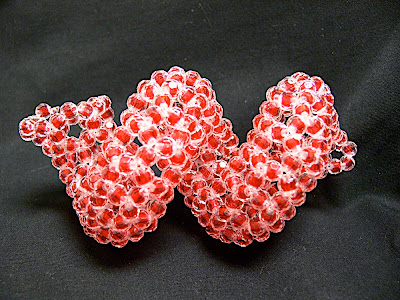


The details of structural rules of HCCNTs can be found in the following three papers we published:
Chuang, C.; Fan, Y.-C.; Jin, B.-Y.* Generalized Classification of Toroidal and Helical Carbon Nanotubes J. Chem. Info. Model. 2009, 49, 361-368.
Chuang, C; Jin, B.-Y.* Hypothetical toroidal, cylindrical, helical analogs of C60 J. Mol. Graph. Model. 2009, 28, 220-225.
Chuang, C.; Fan, Y.-C.; Jin, B.-Y. On the Possible Geometries of Helically Coiled Carbon Nanotubes J. Mol. Struct. 2012, 1008, 1-7.
In fact, Chern made a bead model of the same structure a few years ago. But in the Bridges conference held in Pecs, Hungary, I met Laura Shea and gave that model to her as a souvenir. Since then, both Chern and I didn't make any new model of helically coiled carbon nanotubes.
Wednesday, May 30, 2012
Workshops in Japan
I am going to Japan to give a few workshops this Saturday. The tentative schedule for this trip:
June 2-5: Fukuoka University
June 6: Okayama University
June 7: Shiga University, Hikone
June 8-11: Nagoya
June 2-5: Fukuoka University
June 6: Okayama University
June 7: Shiga University, Hikone
June 8-11: Nagoya
Subscribe to:
Posts (Atom)