Saturday, May 22, 2010

Talk given at the Quaker church, Chia-Yi (嘉義市貴格教會 May 4, 2010)

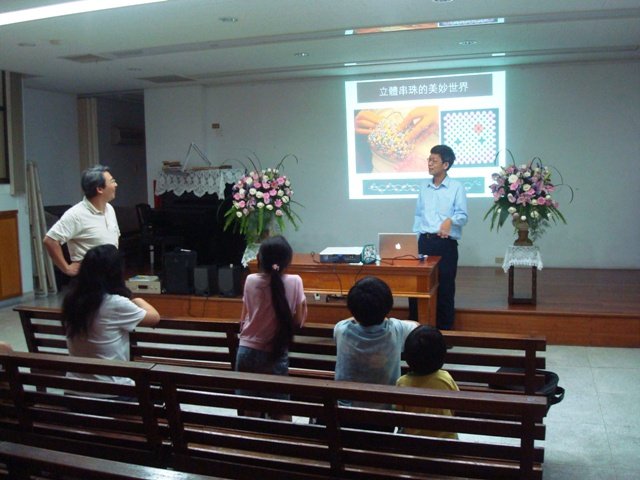
My college classmate, Prof. Liao, invited me to Chung-Cheng university (中正大學) to give a talk. Chung-Cheng university is located at Chia-Yi county, a city in the southern Taiwan. The subject of my talk is about quantum transport through a single molecular wire consisting of multiply connected pathways. Another college classmate, Du, who is a priest at Quaker church of the Chia-Yi city (嘉義市貴格教會), also come by to listen my talk. We have not seen each other for almost 20 years since the last time we met at Boston when we were still graduate students. After the talk, we went to his church. Du insisted me to give a short talk about the beading at his place since his wife was trained as a mathematician originally, and might be interested in this subject. So, I gave a 30-min talk. Here are some photos from the talk:

Beginning of the talk


People seem to be interested in the talk at the beginning:


Getting bored?


A really bad example as an audience :-)


The end of my talk:


I had a picture with the family:


I had a picture with the only kid who didn't fall asleep. She might be a potential scientist or artist.


Liao, Du, and me:

Friday, May 21, 2010

buckyball, buckyball, everywhere...

A few photos from the NTU Azalea Festival 2010 (2010臺大杜鵑花節):
More pictures

Students at chemistry department of National Taiwan university seem to be fond of making colorful bead models for C60.


Thursday, May 6, 2010

Dual graph of a honeycomb lattice

I found this beadwork, a physical model of dual graph of a honeycomb lattice, in the kitchen of my parent-in-law's house.

My new office

Finally, I have moved to a new office with a pretty nice glass display cabinet for my beaded fullerenes in the middle of the office.


Tuesday, April 13, 2010

Procedure of creating a high-genus fullerene

Here are a few pictures of another high-genus fullerene I made last month. This structure contains 12 necks, each of them is made of 5 octagons again.
To make this molecule, I have used approximately six long threads with around 4 meters each.

It is clear that we have to weave the inner part of a HG-fullerene first, in this case, 12 necks connected to each other.

Note also that this structure is, I believe, one of the two simplest high-genus fullerenes with icosahedral symmetry one can create. Another icosahedral HG-fullerene has 10 heptagons in each of 12 necks.