
Showing posts with label Japan. Show all posts
Showing posts with label Japan. Show all posts
Thursday, March 26, 2015
Torus knot (2,9) by Kazunori Horibe
Kazunori email these photos of a beautiful bead model of (2,9)-Carbon nanotube torus knot (CNTTK) he just made the other day. To make the structure more clearly, I also use the Grapher to create the corresponding torus knot.


Tuesday, July 8, 2014
The weight of mathematics
Is there a weight for a mathematical problem? The answer is Yes, if you talk about the Sangaku problem from the Edo period of Japan. Under the kind arrangement of Prof. Sonoda and Mr. Horibe during my visit to Nagoya this May (May 11, 2014), I was fortunate enough to see a few wooden Sangaku tablets, replica and original one, and really saw that mathematical problems can be really heavy. The next day after Horibe-San gave a workshop, Dr. Fukugawa Hidetoshi and I gave the other two talks in the Nagoya City University, we visited two temples in the Nagoya area.
Dr. Fukagawa is the premier authority on the Sangaku tablets in Japan. But he had a serious cold in that weekend, but still insisted to go with us to visit these places. In addition to him and me, we were also jointed with Mr. Horibe, Prof. Sonoda, one local high school math teacher to see these Sangaku wooden tablets.
The first temple we went is the Atsuta Shrine(Atsuta Jingu/熱田神宮). Right after we arrived, we were guided to a special room in the second floor by people from the Shrine, where the replica of two Sangaku tablets (dated 1841 and 1844, respectively) are carefully stored and not on display usually. Because we were special guests of Dr. Fukagawa, so we were lucky enough to have the privilege to examine these two beautifully-made replica.


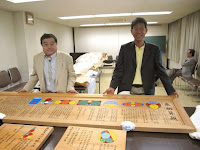

After we had a brief lunch at Atsuta Shrine, Mr. Horibe brought us to a beautiful temple, Yourinzi temple (明星輪寺), in a nearby mountain area, Mount Ikeda (Ikeda-yama, 金生山) of Ogaki city, Gifu prefecture (岐阜縣大垣市). In this Buddhist temple, there is a well preserved Sangaku tablet made in 1865. Most importantly, many mathematicians and physicists, including Freeman Dyson, have been invited by Dr. Fukagawa to visit this temple to see the Sangaku tablet before.


Dr. Fukagawa is the premier authority on the Sangaku tablets in Japan. But he had a serious cold in that weekend, but still insisted to go with us to visit these places. In addition to him and me, we were also jointed with Mr. Horibe, Prof. Sonoda, one local high school math teacher to see these Sangaku wooden tablets.
The first temple we went is the Atsuta Shrine(Atsuta Jingu/熱田神宮). Right after we arrived, we were guided to a special room in the second floor by people from the Shrine, where the replica of two Sangaku tablets (dated 1841 and 1844, respectively) are carefully stored and not on display usually. Because we were special guests of Dr. Fukagawa, so we were lucky enough to have the privilege to examine these two beautifully-made replica.


After we had a brief lunch at Atsuta Shrine, Mr. Horibe brought us to a beautiful temple, Yourinzi temple (明星輪寺), in a nearby mountain area, Mount Ikeda (Ikeda-yama, 金生山) of Ogaki city, Gifu prefecture (岐阜縣大垣市). In this Buddhist temple, there is a well preserved Sangaku tablet made in 1865. Most importantly, many mathematicians and physicists, including Freeman Dyson, have been invited by Dr. Fukagawa to visit this temple to see the Sangaku tablet before.


Thursday, December 27, 2012
High-geneus fullerene by Mr. Horibe
I just got an email from Mr. Horibe with a link to his page, which gives many photos on the different stages of making a dodecahedral high-genus fullerene. It should be useful for anyone who wish to make this model.
 Mr. Horibe also emailed me a beautiful picture of
the backyard of his house in Tajimi. We took a picture together
at the same place this June, without snow though.


Friday, June 15, 2012
Bead model of small stellated dodecahedron
Another class of bead models made by Mr. Horibe is the small stellated dodecahedron, which is one of the Kepler–Poinsot polyhedra.

The basic idea of making this kind of dendritic dodecahedra is to choose a suitable size of Goldberg polyhedron and then grow a short segment of endcapped carbon nanotube along each pentagon. In this particular case, the endcapped CNTs are just hemisphere of C20s. Similar trick to make dendrite-like structures is used in many of Mr. Horibe's work.

The basic idea of making this kind of dendritic dodecahedra is to choose a suitable size of Goldberg polyhedron and then grow a short segment of endcapped carbon nanotube along each pentagon. In this particular case, the endcapped CNTs are just hemisphere of C20s. Similar trick to make dendrite-like structures is used in many of Mr. Horibe's work.
Thursday, June 14, 2012
Mr. Horibe's story
Yesterday, Mr. Horibe informed me with email that he made the first regular polyhedron with duralumin tubes around 1975. After that he was busy on teaching and nothing was done for a while.
However, around 1995, he made the first bead model of dodecahedron which was consisting of 30 balls based on the problem described in the famous math book (Sangaku book, 算法助術) from the Edo period (江戶時代) of Japan. Since then, he started to make many different kinds of mathematical beadworks alone for about 17 years until we met last week. He said he will keep on making more bead models.
However, around 1995, he made the first bead model of dodecahedron which was consisting of 30 balls based on the problem described in the famous math book (Sangaku book, 算法助術) from the Edo period (江戶時代) of Japan. Since then, he started to make many different kinds of mathematical beadworks alone for about 17 years until we met last week. He said he will keep on making more bead models.
Wednesday, June 13, 2012
Sangaku and mathematical beading
Mr. Horibe, as a math teacher in Japan, is particularly interested in the connection between mathematical beading and the traditional Japanese temple mathematics, namely Sangaku (算額). His teacher and colleague, Hidetoshi Fukagawa ( 深川英俊), is famous for his work on Sangaku and published a book, Sacred Mathematics: Japanese Temple Geometry, with Princeton's physicist Tony Rothman.

There are a few questions of Sangaku which are related to tangent spheres. For instance, the following problem appears in Fujita Kagen’s 1796 edition of Shinpeki Sanpo. (Collection of Fukagawa Hidetoshi.)

The translation of this problem given in the "Sacred mathematics" is
"Twenty small balls of radius r cover one big ball of radius R where each small ball touches three other small balls. Find R in terms of r."
Another problem related to the bead model of C20 appeared in 1830 book Sanpo Kisho, or Enjoy Mathematics Tablets, by Baba Seitoku (1801–1860)

In this problem, small spheres correspond to beads that represent 30 edges of a dodecahedron.
To illustrate these two problems, Mr. Horibe made a beautiful, but non-standard bead model consisting of 20 ping-pong balls punctured with three holes at suitable places in order to connect them with an elastic rubber string. Of course, this model is a dodecahedron with ping-Pong balls located at the 20 vertices. Using the similar technique, he also made a bead model of an icosahedron consisting 12 Ping-Pong balls located at the vertices too.

To illustrate the second problem with 30 small spheres in touch with a large central sphere, Mr. Horibe did something even more amazing. He tried to make a composite bead model for the problem 2. This model consists of 30 small spheres outside (i.e. a dodecahedron) and a large sphere inside with small and large spheres satisfying the correct ratio of their radii, i.e. R=sqrt{5} r. This was a difficult task. Mr. Horibe quickly realized that it was very expensive to ask people to made two wooden beads exactly with this ratio. So he could only look around for different kind of balls in many stores in Japan, particularly he always brought a calculator and a ruler with him to measure if he was lucky enough to find out just the right beads that satisfied this condition. Quite fortunately, he found out a right size of metal ball for the central large sphere. So he made two nice models, one for Fukagawa and another for himself, for the famous Sangaku problem. In the following pictures I took at Nagoya's Children and Family Center, you can see how Mr. Horibe stretched the small spheres apart and pull the inner large sphere out. It was quite a show.

Tuesday, June 12, 2012
Two gifts from Mr. Horibe
I am usually the person who gave people beadworks as gifts. But I myself got a beaded C60 as a gift from Mr. Horibe on our visit to his home. And the next day, when he participated my workshop in Nagoya, I got another giant torus as a gift.


His model is quite different from mine because most often he used only a single elastic rubber band with exact length to make his beadworks. In this sense, the path of his elastic string exactly corresponds to the Hamiltonian path exactly and has, of course, the minimal length for a particular model. So, the elastic string passed every bead in the model twice and only twice. To avoid beads fall apart, Mr. Horibe then made a knot in the end. So you can pull or press his bead models to some extent.
Possibly due to his training as mathematics teacher, he always uses a single string even for structures that contain more several thousand beads. I was quite surprised when I just heard of it. Just imagine how one can use a single string to bead the giant green stellated dodecahedron as shown in the following photo. The problem is that it would become very difficult to bead with such a long string. The good thing is that the path of string in his case is really a Hamiltonian path no matter how many beads a model contains. I guess that he also needed to plan well before he started because it is not always trivial to find out the Hamiltonian path. Sometimes, we just got trapped as weaving process goes. I don't know how he managed to do it with only one string especially for certain structures that has more than several thousand beads.

Another practical aspect about using elastic string is that elastic string is much thicker than the Nylon string I typically used. I suspect that it may not easy to pass it through three times through a hole. But of course, it is not a good idea to pass string through some beads twice, but some other beads three times because that will make the tension generated by the rubber band uneven throughout the structure. There is no such problem for the Nylon string because the bead models made by Nylon string are usually quite strong and hard. So it is harder to deform them like the model made with elastic rubber band.
Monday, June 11, 2012
Bead models of dodecahedron and icosahedron
Mr. Horibe started to play with polyhedral models very early. According to him, he has constructed Platonic models with a long cylindrical tube capped with two beads when he was still an undergraduate student in the 70s.
He demonstrated in front of us that dodecahedron and icosahedron are dual to each other using this kind of models. With long cylindrical tubes, the whole structure becomes very flexible, so you can compress it and put one inside the other. Students can realize, through this amazing way, why dodecahedron and icosahedron are dual to each other. I can only say that Mr. Horibe must be a very effective math teacher. I wish I could learn math from him when I was a high school student.


In some sense, this kind of bead models is very similar to the so-called tensegrity structures. BTW, Mr. Horibe usually uses a single elastic string for making his bead models, which makes his models even more flexible and bendable. I will comment more on this aspect later.
Some more amazing beadworks of Horibe with comments on colors in bead models
Most of Horibe’s beadworks are made by single color. Unlike beadworks made by my group, I usually decorated nonhexagons with different colors or use colors to represent single and double bonds. Of course, this will spoil the color of hexagons and nonhexagons. It is not possible to use colors independently for hexagons and nonhexagons. There must be some polygons, which will be decorated with more than two colors when one chooses to use more than one color. According to him, that is the reason he usually used single color to do beading to avoid this situation. Only in a few examples he used two colors to illustrate some particular features.


But, to chemists, using colored beads seems to be an obvious choice. Chemists have been using many kinds of molecular models to represent microscopic structures of molecules. It is quite common to use different colors to denote different kind of atoms. Now, in bead models, we move the emphasis from atoms to bonds. It is still apparent that one could also employ colors to mean different things. Faces in a molecular network do not have important chemical meanings as those of vertices (atoms) and edges (chemical bond). But more importantly, we would view the color pattern as a new dimension of beaded molecules, which can not only give geometric or chemical meaning, but also make them more visually pleasing.


But, to chemists, using colored beads seems to be an obvious choice. Chemists have been using many kinds of molecular models to represent microscopic structures of molecules. It is quite common to use different colors to denote different kind of atoms. Now, in bead models, we move the emphasis from atoms to bonds. It is still apparent that one could also employ colors to mean different things. Faces in a molecular network do not have important chemical meanings as those of vertices (atoms) and edges (chemical bond). But more importantly, we would view the color pattern as a new dimension of beaded molecules, which can not only give geometric or chemical meaning, but also make them more visually pleasing.
Visiting Horibe and workshop at Nagoya Child and Family Center
Under the great arrangement of prof. Sonoda, I have this opportunity to visit Mr. Horibe in his place in the Aichi prefecture last Saturday (6/9/2012), two days before I returned back to Taiwan. It was really nice to meet him and saw many of his amazing mathematical beadworks. But, he doesn't speak English, so I can only communicate with him mainly through the translation of Prof. Sonoda. Most often, they spoke to each other in Japanese. But I still had plenty of time taking pictures and inspected his beadworks. I hope my understanding about his work is correct. I will post some of his beadworks and also compare his works with mine in the next few posts. But what I wrote could be my misunderstanding.


I knew Mr. Horibe and his beadworks through Prof. Sonoda two years ago. As I mentioned before that Prof. Sonoda is a missionary of cube kaleidoscope and has the passion to share this activity to kids all over the world. He visited Taiwan two years ago to give not only his own chemistry research, but also a workshop on the cube kaleidoscope. I participated both events and also shown him my works on beaded molecules. After he returned to Japan, he knew quite accidentally from a secretary of Prof Ono that a local high school teacher had set up a website which contains a lot of similar mathematical beadworks. So prof. Sonoda informed me about Horibe's beadworks immediately. Finally we have the chance to meet each other.
On Sunday, Mr. Horibe and his wife also participated the workshop held at Nagoya Child and Family Center near B's Hotel hosted by Ms Hiroe Takeuchi (6/10/2012).

Friday, June 8, 2012
Japanese translation of 珠璣科學─串珠碳六十
Prof. Inoue (井上吉教) of Hikone prefecture university and one of his Chinese students kindly translated my article "珠璣科學─串珠碳六十" (The Science of Beading - Beaded C60) with Dr. Tsoo for the March issue of the "Science Monthly (科學月刊)" magazine.

(New post, scanned images 6/12/2012)


Prof. Inoue also made a few fullerenes as shown in the following pictures. I didn`t check them very carefully. Possibly, one of them is the icosahedral C80 and another is the cylindrical shape C84. There seems to be a fullerene belonging to D3h point group.


(New post, scanned images 6/12/2012)


Prof. Inoue also made a few fullerenes as shown in the following pictures. I didn`t check them very carefully. Possibly, one of them is the icosahedral C80 and another is the cylindrical shape C84. There seems to be a fullerene belonging to D3h point group.


Monday, June 4, 2012
Workshop at the Ito campus of Kyushu University
Workshop 16:40-19:00 for ca 150 first-year undergraduate students assisted by Yasushi Kita and Kumiko Okayama.
Talk and workshop titled as "Molecular modeling of fullerenes with beads: a hands-on approach"


Subscribe to:
Posts (Atom)