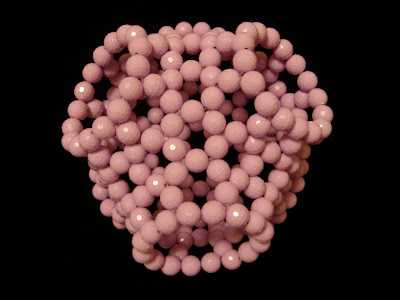
A group of students, 紀彥仰 (Electrical Engineering), 戴子宜(Electrical Engineering), 吳柏成(Computer Engineering),
in my class, Molecular Aesthetics 2020, designed and built a beautiful bead model of Menger sponge.
Showing posts with label cubic systems. Show all posts
Thursday, June 25, 2020
Saturday, July 26, 2014
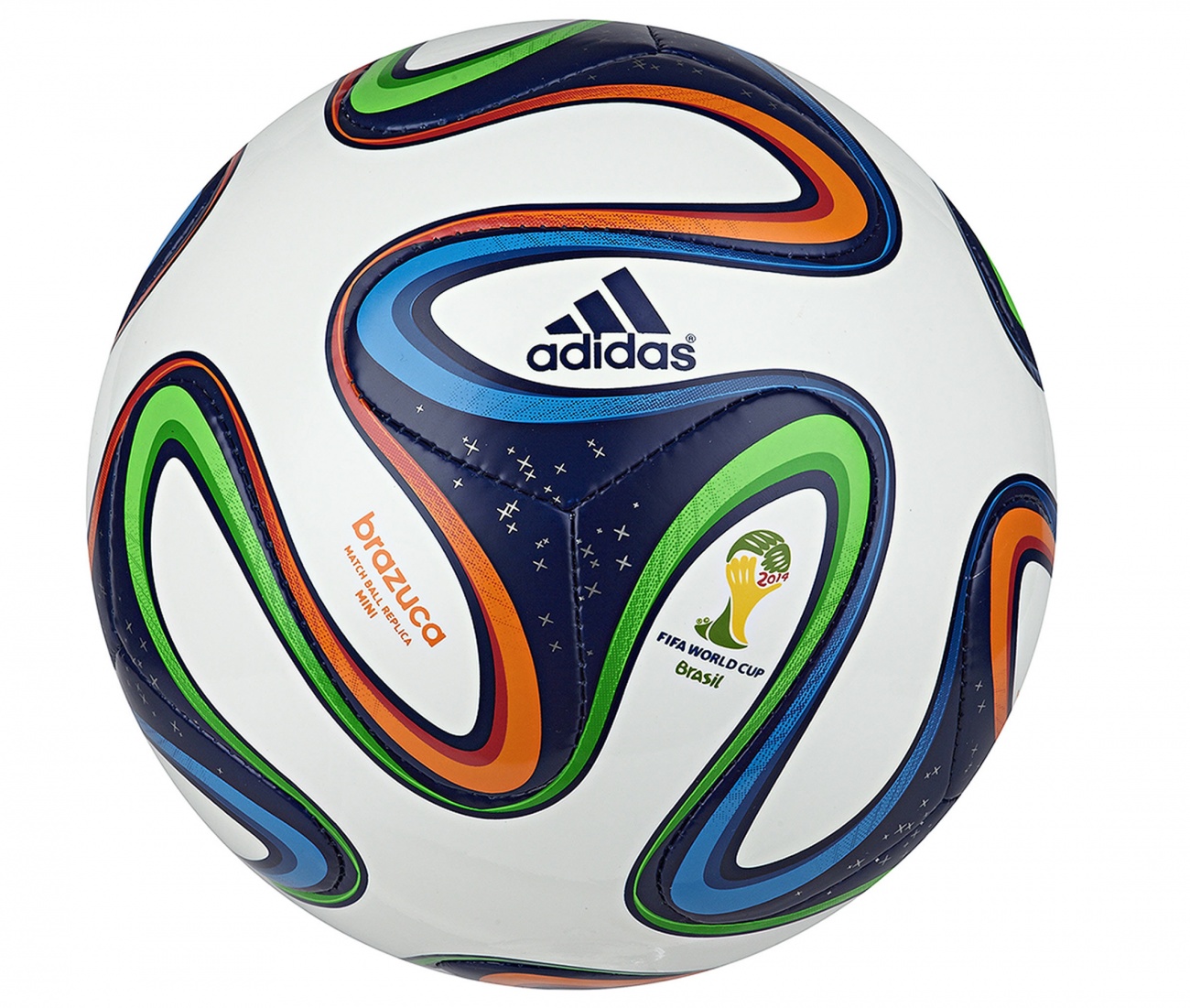
"Mathematicians Solve The Topological Mystery Behind The “Brazuca” World Cup Football Just in time for the World Cup final"
I just noticed that there is a page from Medium - Everyone’s stories and ideas,
Mathematicians Solve The Topological Mystery Behind The “Brazuca” World Cup Football Just in time for the World Cup final,
which reported the manuscript, From the "Brazuca" ball to Octahedral Fullerenes: Their Construction and Classification, Yuan-Chia Fan and I submitted to the arXiv at the end of last month.
In fact, Yuan-Jia has been working on the general structural rules for this peculiar family of generalized fullerenes with octahedral symmetry for a period of time. When the FIFA World Cup started in the mid June, I noticed quite accidentally that the official soccer ball, the “Brazuca”, for the FIFA World Cup held in Brazil this year has exactly the same octahedral symmetry. Then, we rewrote the draft a little bit and changed the title to its current form. However, the manuscript was first rejected by the Journal of Chemical Information and Modelling because the paper is not of general interest to the readers of the journal. And then it was rejected again by the Journal Physical Chemistry A because the editor thought this paper falls outside the bounds of the journal.
Instead of finding another journal, I decided to put it in the print archive, arXiv, at the end of June. So people might find it interesting during the World Cup season.
The evolution of the official Adidas Soccer Balls since 1970.
In addition to the page on Medium - Everyone’s stories and ideas, I also noticed three more pages which refer to the Yuan-Jia's work on the octahedral fullerenes and their connection to the Brazuca:
Sunday, July 6, 2014
The Brazuca and octahedral fullerenes
Yuan-Jia and I submitted a manuscipt entitled, From the "Brazuca" ball to Octahedral Fullerenes: Their Construction and Classification, to the physics preprint archive, arXiv, recently. Basically, we observed that the symmetry of the Brazuca ball used in the FIFA World Cup held now in Brazil is exactly that of an octahedral fullerene, which Yuan-Jia has been thinking about for more than a year. Therefore, we modified the original manuscript a little bit to point out this peculiar connection. Hopefully, researchers can know that not only the original the Adidas Telstar, a truncated icosahedron, has a microscopic analog, namely the famous C60, the current Brazuca ball could also have microscopic correspondence, in principle.
The Adidas Telstar vs a C60 molecule
The Adidas Brazuca vs an octahedral fullerene
Here I give a list of symmetry groups for all official match footballs (soccer balls) adopted by the FIFA since 1970:
It is interesting to note that it took FIFA 28 years to move away from the icosahedral symmetry to the tetrahedral symmetry, and then another 12 years to come to the last of three Platonic symmetry groups, namely the octahedral group. Another peculiar difference between the Brazuca ball and the previous soccer balls is the lack of inversion and mirror symmetries in the Brazuca ball, meaning that the Brazuca ball is chiral. This should lead to nonvanishing coupling between translational and rotational (spinning) motions, I suspect.
The Adidas Telstar vs a C60 molecule
The Adidas Brazuca vs an octahedral fullerene
Here I give a list of symmetry groups for all official match footballs (soccer balls) adopted by the FIFA since 1970:
| Year | Country | Name of the official match ball | Point group |
|---|---|---|---|
| 1970 | Mexico | The Adidas Telstar | Ih |
| 1974 | West Germany | The Adidas Telstar Durlast | Ih |
| 1978 | Argentina | The Adidas Tango Durlast | Ih |
| 1982 | Spain | The Adidas Tango Espana | Ih |
| 1986 | Mexico | The Adidas Azteca | Ih |
| 1990 | Italy | The Adidas Etrvsco | Ih |
| 1994 | USA | The Adidas Questra | Ih |
| 1998 | France | The Adidas Tricolore | Ih |
| 2002 | Korea Japan | The Adidas Fevernova | Ih with T pattern |
| 2006 | Germany | The Adidas Teamgeist | Th |
| 2010 | South Africa | The Adidas Jabulani | Td |
| 2014 | Brazil | The Adidas Brazuca | O |
It is interesting to note that it took FIFA 28 years to move away from the icosahedral symmetry to the tetrahedral symmetry, and then another 12 years to come to the last of three Platonic symmetry groups, namely the octahedral group. Another peculiar difference between the Brazuca ball and the previous soccer balls is the lack of inversion and mirror symmetries in the Brazuca ball, meaning that the Brazuca ball is chiral. This should lead to nonvanishing coupling between translational and rotational (spinning) motions, I suspect.

Saturday, December 28, 2013
Wednesday, July 4, 2012
From carbon cube to Schoen's I-WP surface
As I mentioned in the previous post, we can create necks by replacing every pentagon around corners by a heptagon. The structure thus obtained is a single unit cell for the Schoen's I-WP surface! The eight necks in this particular case are, however, too thin to be chemically stable.
Tuesday, July 3, 2012
Carbon cube
Using the same combination of an octagon together with four pentagons for a face as described in the carbon cuboctahedron, one can make the following bead model of the carbon cube. Each corner of a cube is mimicked by three fused pentagons. In principle, we can use the same strategy to create a whole series of fullerenes with the shape of a truncated cube.
Monday, July 2, 2012
Carbon cuboctahedron
Most of cage-like fullerenes belong to either icosahedral or tetrahedral groups. But if we remove the restriction of using only pentagons and hexagons, we can create cage-like fullerenes with octahedral symmetry (or cubical shape) too. Of course, all P-type TPMSs, which are extended systems, posted before have the same symmetry. But I have never made cage-like fullerenes with cubical shape before. I found a few examples of cage-like fullerenes with cubical shape in an interesting book with the title, Periodic Nanostructures, by M. V. Diudea and C. L. Nagy recently. In this structure, each face contains an octahedron surrounded by four pentagons, which give a topological charge of 2. There are six faces in a cube, so the total topological charge is 12 as required by the Euler theorem. It is also easy to see that the eight vertices of this molecule are covered by flat coronenes. Therefore, the molecule looks like a cuboctahedron (立方八面體).
It is not hard to see that one can grow eight carbon nanotubes along eight vertices of the cube. The result will be a Schoen's I-WP surface I described before. If one inserts six tubes along the six faces, one get a single unit cell of the P-surface. Or one can also terminate the CNTs to get a dendritic fullerene with a cubic-shape core.
Thursday, April 19, 2012
P-surface with (1,0) vector
Chern made this (1,0) P-type triply periodic minimal surface with 4mm beads many years ago. I might have posted it long time ago, but forgot to make a suitable keywords for that post, so I couldn't find anywhere in this blog.
Chern used a different color coding for this bead model, i.e. orange for hexagons and black and organe alternatively for octagons. Since there is no bead which is not in octagons, one would get a single color bead model by using the color coding we adopted typically.
Wednesday, April 18, 2012
(1,1) and (2,0) P-type Triply Periodic Minimal Surfaces
It would be nice to compare two P-type TPMSs, one with the Goldberg vector (1,1) and the other with (2,0), together. Here the Goldberg vector, (m,n), denotes the separation between two neighbored octagons. In this sense, (1,1)-P-TPMS is similar to C60, while (2,0)-P-TPMS to C80 in the spherical space.
Sunday, March 18, 2012
P-surface with the Goldberg vector (1,1)
In principle, it is possible to construct a graphitic P-surface with neighbored octagons separated by any Goldberg vector, (h, k). Most of the beaded P-surfaces I posted before have the vector (2,0). The smallest graphitic P-surface has a vector of (h,k)=(1,0) and its bead model was built by Chern long time ago.
Here is the bead model of P-surface with (1,1) I made this weekend. Unlike (2,0)-surface, the bead model of (1,1)-surface is a little bit crowded though.
Single unit cell:
2x2x2:
Here is the bead model of P-surface with (1,1) I made this weekend. Unlike (2,0)-surface, the bead model of (1,1)-surface is a little bit crowded though.
Single unit cell:
2x2x2:
Monday, September 26, 2011
P, D, and G triply periodic minimal surfaces
Tuesday, June 15, 2010
Another 2x2x2 P-type triply periodic minimal surface
Friday, June 4, 2010
2x2x2 bead model of Schoen's I-WP surface
Chern Chuang (莊宸) created this amazing graphitic structures consisting of a Schoen's I-WP surface decorated with graphene sheet. The I-WP surface, found by Schoen in 1970, is a TPMS of cubic symmetry Im3m. In addition to I-WP surface, there are other TPMSs of Im3m symmetry, such as Schwartz P and Neovius surfaces.
Chuang figured out the systematic structural rule for this kind of periodic minimal surface at the beginning of this year. Based on his post, I constructed a 1x1x1 bead model for this structure using three different colors of beads. Apparently, he seems to find time to bead even in the army. Now we have this beautiful 2x2x2 bead model created with 5mm semi-transparent plastic beads. Based on the previous post by Chuang, there are 3456 carbon atoms in the structure. So one need about 5000 beads to create it. It is quite a work.
I am kind of surprised by the strong mechanical strength of this structure. Unlike bead models for other minimal surfaces including Schwartz P or D surfaces, this model seems to be quite rigid, and a little bit like that of a brick. So, it may not be a bad idea to have this kind of 2x2x2 I-WP surface as a high-strength but low-density brick for purpose of construction. The only problem is that it is quite difficult to create even just one of this kind of bricks. We may solve the problem if we can invent a robot to weave them automatically.


The 2x2x2 I-WP surface and my friend's iPad:
Thursday, February 11, 2010
Beaded Model for Neovius's Surface Decorated with Graphene
Sunday, February 7, 2010
Beaded model for Schoen's I-WP surface
Sunday, April 8, 2007
P-type Carbon Schwartzite: Periodic Minimal Surface
Chuang Chern made this beautiful model of carbon Schwarzite of type P a few months ago. I didn't take picture for this model until now. There are some other types of Schwartzites such as the type D system, which I have made one right after I saw Chuang's work.
Although the details of weaving are quite complicated, the resulting beaded model is beautiful. It is easy to see that the P-type Schwartzite as shown in the figure (just one unit cell) belongs the octahedral symmetry. Due to the translational symmetry, the whole periodical structure can be extended along six directions indefinitely. I wish we can make a beaded model with eight-unit cell for this system.

This model is made of 10mm faceted beads. The physical dimension is much larger compared with the other models (4mm beads usually) we have made.

In one of pictures in the previous post, if you are careful enough, you should be able to find a beaded model corresponding to the D-type Schwartzite.
Although the details of weaving are quite complicated, the resulting beaded model is beautiful. It is easy to see that the P-type Schwartzite as shown in the figure (just one unit cell) belongs the octahedral symmetry. Due to the translational symmetry, the whole periodical structure can be extended along six directions indefinitely. I wish we can make a beaded model with eight-unit cell for this system.
This model is made of 10mm faceted beads. The physical dimension is much larger compared with the other models (4mm beads usually) we have made.
In one of pictures in the previous post, if you are careful enough, you should be able to find a beaded model corresponding to the D-type Schwartzite.
Subscribe to:
Posts (Atom)