
Wednesday, August 29, 2007


Catenoid-Helicoid vs Torus-Nanospring
Two most famous minimal surfaces are the catenoid and helicoid as shown by the figures from the Indiana university.


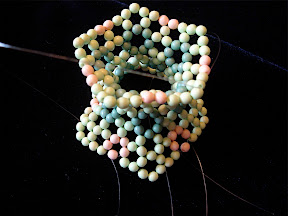
In fact, we have already created these two surfaces at the intermediate stages in weaving torus and nanospring. One can obtain these two kinds of minimal surfaces simply by throwing away all pentagons.
I don't have good examples to illustrate this point, hopefully, we can create some beaded models to demonstrate this. Here is a picture that I tried to show how to make T120. Interestingly, in the intermediate stage, I have a catenoid.
 |
Tuesday, August 28, 2007
Schwarz H Surface
The minimal surfaces at the Indiana university has a beautiful Minimal Surface Archive. Here are two pictures of Schwarz' H-surface I found in that site:


Believe it or not. Chuang Chern has constructed a beaded model for this IPMS. I will ask him to post it later. It is now natural to ask whether all IPMS can be tiled by graphene sheets or not.
Believe it or not. Chuang Chern has constructed a beaded model for this IPMS. I will ask him to post it later. It is now natural to ask whether all IPMS can be tiled by graphene sheets or not.
Helically-coiled tube in 劍湖山
I found these two interesting helically coiled macrotubes in 劍湖山 yesterday.

Saturday, August 25, 2007
Google sketchup for molecular modeling?
I checked the google 3D warehouse and found many interesting models including domes, polyhedrons, buckyballs. I am wondering the possibility of creating either the arbitrary sp2 carbon structures or more challangingly the beaded models with the google sketchup, which seems to be a very good free software for the 3D CAD.
The figure below shows a few sample objects I found from the 3D warehouse.

Personally, I found the polyhedral dome in the upper right corner interesting. It would be interesting if we can build toroidal-shaped dome. Additionally, the google sketchup seems to provide the best free software for us to play with the idea of public arts.
Saturday, August 18, 2007
On weaving rules again
Previously, I suggested that there are essentially two kinds of rules in weaving a beaded model: local and global. Local rules consist of the description of tiles such as 5-, 6-, 7-, and 8-gons and the how to connect these polygons locally. For gyroidal graphenoid, the local rules are quite clear, but the global rules are harder. I have thought about what I meant by the global rules these two days. It seems to me that the global rule is something like the weaving codes I developed for small fullerenes. Somehow this is similar to the Hamiltonian chain that specify how the weaving procedure goes. Of course, it is easy for simple object like the simply-connected fullerenes. However, it becomes not so clear for gyroidal graphenoid. What is the simplest weaving path (the Hamiltonian chain) for this system. I don't think Hamiltonian chains exist in this system. (Maybe I am wrong) But in order to weave this system effectively, maybe we should have a better global rule.
Another way to handle this is to follow Chuang's recipe and weave many unit cells and patch them together. It may also be the best way to build gyroidal graphenoid since I have played with my local and global rules for several hours without success. Then we can simply forget what I say here.
Another way to handle this is to follow Chuang's recipe and weave many unit cells and patch them together. It may also be the best way to build gyroidal graphenoid since I have played with my local and global rules for several hours without success. Then we can simply forget what I say here.
Subscribe to:
Posts (Atom)