Wednesday, March 14, 2012

photos from TFGH

Fan-Fei (周芳妃老師), chemistry teacher of the Taipei First-Girls' High School (TFGH), informed me a site with many pictures she and her colleagues took for several events from Nov. 9 to Dec. 11, 2011.

1. Nov. 9, 2011: students and teachers of TFGH attent my exhibition "The Fabulous World of Beaded Molecules" held in our department.
2. Nov. 28, 2011: Students of TFGH visited our department and I gave a talk "珠璣科學" for them.
3. Nov. 2-11, 2011: We collaborated on the superbuckyball.

Monday, March 12, 2012

Eight structural types of TCNTs with latitude coordinates

Here are all eight structural types of TCNTs in the show case located in the third floor of chemistry building(NTU). Four of them belong to Dnh point group and the other four belong to Dnd group. Chern made the three in blue and white long time ago and I made the other five in red in order to have the whole set with 6mm faceted beads after I read the paper in Chem. Eur. J.

Tuesday, March 6, 2012

Dodecahedral Carbon Schwarzite

Previously, I discussed how to construct a locally hyperbolic tetrahedral building block by puncturing four holes on a tetrahedral C84 along its four tetrahedral axes. This basic unit consists of 12 heptagons, which make the local curvature negative. We can create many different kinds of interesting structures by using this kind of building blocks. One possibility is a dodecahedron. The angle between two axes emanating from the center to two any two vertices (the "tetrahedral angle") of a tetrahedron is 109.47°, which is slightly larger than the inner angle of a dodecahedron (108°). This means that we can use them to construct a dodecahedron without introducing too much local strain. Below is a dodecahedral bead model consisting of 20 such units I just made today. It took me about one week to bead all twenty units and connect them together. More than 2500 8mm faceted beads are used to make this model.


German mathematician Herman Schwarz first proposed P- and D-types triply periodic minimal surfaces (TPMS) in the 19th century. Later, about twenty years ago, Lenosky et al. theoretically suggested graphitic structures with suitable arrangement of seven-membered rings decorated in P- and D-TPMS as possible model structures of sponge carbon. Now, chemists and physicists call this kind of graphitic structures with negative Gaussian curvatures as Schwarzites. The one I have here satisfies this criteria, so we might call it the dodecahedral carbon Schwarzite.

Monday, March 5, 2012

Pillar-shaped C60 and related C72

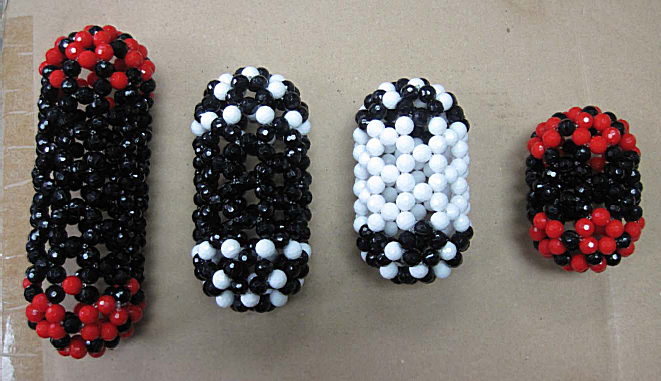
There are 1812 isomers of C60. Only the one with the shape of a soccer ball is stable enough and can be synthesized routinely. However, chemists in the Xiamen university have successfully created a few chlorinated isomers of C60 three years ago. I will try to make bead models of them when I find time. Here I would like to show the bead model of another elusive isomer of C60 with pillar shape (point group, D6h) which might be found someday.
Of course, there is a whole series of pillar-shape fullerenes by simply inserting short rings of carbon nanotubes. Here is the bead model of C72, which is the second one in this series.

Building blocks for pseudo D-type Schwarzite

I just noticed that I already have a picture of punctured C84 in the logo of this blog the other day. I checked my photo library and found another picture of this model which was taken almost five years ago. I possibly made this bead model after reading the paper on Nature with title "Energetics of negatively curved graphitic carbon" by Lenosky et al. (1992 vol. 355, 333-335).


However, we now know this is not a true triply periodic minimal surface. The correct D surface should partition the space into two congruent parts. It is not possible to get such a structure if one use heptagons.

Of course, we now know how to make a correct D-type Schwarzite which exactly partition the space into two identical regions. Wei-Chi made this beautiful bead model of D-type Schwarzite a few years ago.