D. Vukicevic and M. Randic have figured out all possible distinct resonance (or Kekule)
structures a few years ago. According them,
buckminsterfullerene has 12500 Kekule structures grouped in 158 isomorphic classes. They also give
a complete list of all these 158 non-isomorphic Kekuke structures in a recent paper
entitled "Detailed Atlas of Kekulé Structures of the Buckminsterfullerene", in the book,
"The Mathematics and Topology of Fullerenes".
This is very convenient if we want to make any particular resonance form of C60. We can simply look at the Schlegel diagrams given in this paper, and pay attention to the single and double bond pattern as we bead.
Here are three bead models for Kekule structures No. 134, 135 and 136 as shown in their paper.
Showing posts with label labyrinth. Show all posts
Sunday, April 15, 2012
Saturday, February 11, 2012
Four more valence bond structures of C70
There could be thousands of VB (valence bond) structures or resonance forms of C70. Here are four possible VB structures.
Monday, January 16, 2012
Another Resonance Structure of C60
Wikipedia has a resonance structure of C60 in its "Buckminsterfullerene" item. I made a bead model with color code according to this resonance form last weekend. Again one can see the interesing pattern of this resonance structure. Also white beads (or single bonds) form a long connected one-dimensional loop.
I also tried to make another resonance structure by only paying attention to the local condition. But at the last loop, I found that I couldn't satisfy the local condition any longer. So I used a red bead to show this frustration.
Thursday, October 20, 2011
VB diagram with T symmetry
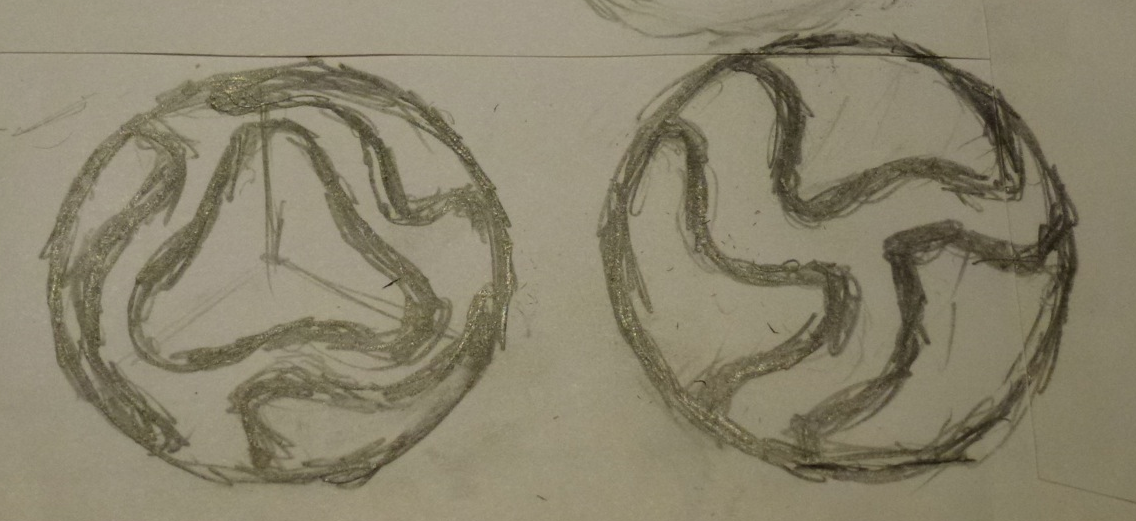
There are many possible VB diagrams for C60. Many of them are still symmetric. The bead model I showed in the previous post corresponds to the kekule structure of single hexagon rotated by one beads, which leads to a fusion of three pentagons into a trefoil. One can also perform this operation on the remaining 9 pentagons at suitable 3-fold axes to produce an interesting pattern which looks like a tiling of four trefoils on a sphere.
I made the following two bead models of C60 to show this pattern. (left column: north hemisphere; right column: south hemisphere)

It is easier to see this pattern with four trefoil tiles using a schematic plot.

(I would be happy to recommend this chiral pattern with T symmetry on a football for the FIFA next time!)
I made the following two bead models of C60 to show this pattern. (left column: north hemisphere; right column: south hemisphere)

It is easier to see this pattern with four trefoil tiles using a schematic plot.

(I would be happy to recommend this chiral pattern with T symmetry on a football for the FIFA next time!)
Wednesday, October 19, 2011
Labyrinth on a buckyball
Using the idea I introduced in the previous post, we can create 220/20 different patterns of labyrinth for C60! The basic idea is to start from the original VB pattern with icosahedral symmetry which I will call the canonical VB structure. Each of 20 hexagons on C60 has two local Kekule structures. We can apply a six-fold rotation to switch them from one to another. In total, we have 220/20 possibilities. But there are still many over-countings. Working out all distinct VB structures is a nontrivial combinatorial problem. Possibly someone has already done it.
Right now, I only have one additional colored beaded C60 with only one local Kekule structure rotated into another resonance form. One can see the curious local 3-fold pattern (3-fold leaf). I will make another bead model of C60 with four local Kekule structures rotated and create four non-overlapping 3-fold leafs, or a tiling on sphere with four 3-fold leafs.
Monday, October 17, 2011
Color pattern and VB structure
I recently communicated with Prof. Gillespie about the bead model of fullerenes. He raised a few questions on the way I interpreted the hard-sphere repulsion and its connection to the VSEPR (Valence shell electron pair repulsion) theory for AX3 systems. (Even though, I am trying hard to convince him that this correspondence with suitable interpretation of beads. He still doesn't think bead model provides an example of VSEPR.) Through the discussion with him, I was inspired to look at the meaning of color beads more carefully.
In all of my previous bead models, I adopted a simple color scheme which is basically using a different color for each kind of nonhexagons. For a shared edge between a hexagon and a nonhexagon, we use nonhexagon's color for that shared edge.
However, we can also adopt a color scheme which has more chemical meaning simply by assigning one color to single bonds and another color to double bonds. From elementary chemistry, we know that each carbon atom has four valence electrons and should form four chemical bonds with its three neighbored carbon atoms in a fullerene. So we should also impose the following rules for arranging single and double bonds to satisfy the correct electron counting and molecular stability:
1. Surrounding each carbon atom, there are four electron pairs corresponding to two single bonds, and one double bonds, which can be represented by two white beads and one red bead, respectively.
2. Two connected double bonds (neighbored red beads) are strictly forbidden.
3. Three single bonds surrounding a central carbon atom will have an extra electron left without bonding and should correspond to a radical. This pattern is not energetically unfavorable and should be avoided either.
Each particular arrangement of single and double bonds correspond to the so-called valence bond (VB) structure. Usually, many VB structures can be found for a particular fullerene. A simple rule of thumb from quantum chemistry is that the more VB structures a fullerene has, the more stable the corresponding fullerene is. The ground state wave-function of the fullerene can be approximately expressed as a superposition of these VB structures.
Finding and enumerating all possible arrangements of single (white beads) and double bonds (red beads) in a fullerene with the above constraints is nontrivial.
As I have pointed out, the color pattern of C60 generated by the color scheme we used before corresponds to the most important VB structure of C60. Basically, in this VB structure, each of 12 pentagons consists of five single bonds and each of 20 hexagons consists of single and double bonds alternatively. One can in principle generate many more VB structures by rotating the single- and double-bond pattern in any of hexagons by one bond unit. This transformed hexagon is another Kekule structure of that hexagon.

In addition to C60, I just constructed a bead model of C70 with a color pattern in consistent with one of its VB structures. It is not hard to see the beautiful labyrinth pattern for this particular color scheme. Although I don't have a proof, I suspect the generality for the existence of labyrinth pattern in the bead model (using this color scheme, of course) of any fullerene without free radical, i.e. carbon only with three single bonds (white beads in the following picture).
A particular VB structure (resonance form) of C70:

The corresponding bead model with a colored VB pattern:
In all of my previous bead models, I adopted a simple color scheme which is basically using a different color for each kind of nonhexagons. For a shared edge between a hexagon and a nonhexagon, we use nonhexagon's color for that shared edge.
However, we can also adopt a color scheme which has more chemical meaning simply by assigning one color to single bonds and another color to double bonds. From elementary chemistry, we know that each carbon atom has four valence electrons and should form four chemical bonds with its three neighbored carbon atoms in a fullerene. So we should also impose the following rules for arranging single and double bonds to satisfy the correct electron counting and molecular stability:
1. Surrounding each carbon atom, there are four electron pairs corresponding to two single bonds, and one double bonds, which can be represented by two white beads and one red bead, respectively.
2. Two connected double bonds (neighbored red beads) are strictly forbidden.
3. Three single bonds surrounding a central carbon atom will have an extra electron left without bonding and should correspond to a radical. This pattern is not energetically unfavorable and should be avoided either.
Each particular arrangement of single and double bonds correspond to the so-called valence bond (VB) structure. Usually, many VB structures can be found for a particular fullerene. A simple rule of thumb from quantum chemistry is that the more VB structures a fullerene has, the more stable the corresponding fullerene is. The ground state wave-function of the fullerene can be approximately expressed as a superposition of these VB structures.
Finding and enumerating all possible arrangements of single (white beads) and double bonds (red beads) in a fullerene with the above constraints is nontrivial.
As I have pointed out, the color pattern of C60 generated by the color scheme we used before corresponds to the most important VB structure of C60. Basically, in this VB structure, each of 12 pentagons consists of five single bonds and each of 20 hexagons consists of single and double bonds alternatively. One can in principle generate many more VB structures by rotating the single- and double-bond pattern in any of hexagons by one bond unit. This transformed hexagon is another Kekule structure of that hexagon.

In addition to C60, I just constructed a bead model of C70 with a color pattern in consistent with one of its VB structures. It is not hard to see the beautiful labyrinth pattern for this particular color scheme. Although I don't have a proof, I suspect the generality for the existence of labyrinth pattern in the bead model (using this color scheme, of course) of any fullerene without free radical, i.e. carbon only with three single bonds (white beads in the following picture).
A particular VB structure (resonance form) of C70:

The corresponding bead model with a colored VB pattern:
Subscribe to:
Posts (Atom)